Introduction
Roll-type straightening units and systems, as well as their component elements and the results that can be achieved with them, are increasingly becoming the focus of attention in the manufacture and processing of wire-shaped process materials. In addition, the roll straightening process, which is characterised by an increased level of automation and linking, must meet the challenge of higher process speeds, advanced materials and a stronger awareness of quality and the environment. Motivation
Advanced straightening technology provides the tools to meet these requirements. Technical solutions that ensure precise, reproducible positioning of the straightening rolls are particularly significant.
Straightening units could be used, for example, which are equipped with mechanical displays to provide information about the position of the straightening rolls when the rolls are adjusted (Figure 1). Semi-automatic straightening technology[1,2], which uses modern drive and automation technology, or straightening units that use the Computerised Tool[3] to position the rolls, fulfils the expectations placed on them regarding reproducibility and the precise adjustment of the straightening rolls. |
Figure 1: Straightening unit from the ER series, with mechanical position display
|
Any technical solution, however, relies on knowing what the required roll positions are. If this knowledge is not available, it has to be worked out, but this subjective process involves high costs resulting from the time, material, labour and energy involved. From both the economic and technical standpoints, this situation is untenable.
A representation of the roll-type straightening process
To address the problem, Witels Albert, Germany, has set itself the goal of creating a virtual representation of the roll-type straightening process, so that the roll positions can be calculated a priori. As has been shown in numerous straightening trials, this goal can be accomplished by simulating the roll straightening process[4]. Simulation is based on a theoretical model of the elastic-plastic alternating deformation of a process material and the link between bending moment and curvature, which can be defined for every bending operation which is performed in the straightening equipment. This allows calculation of the bend characteristic ?(x) in an item to be straightened. The characteristic can then be used to calculate the positions of the rolls aRi = y(x) by numerical integration of the second-order differential equation (Equation 1), which applies to deformation caused by bending. To create a simulation of the process, knowledge of the process material characteristics and the geometric characteristics of the particular straightening unit is required[5].
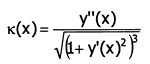
Given the large variety of applications for straightening units, the diversity of types and models, and the varying objectives of differentiated straightening processes, it is often desired that the simulation process be moved directly into the wire manufacturing or processing environment. The operators themselves should be given the tools to calculate the required positions of the rolls. To address the complexity of process simulation, a method has been developed based on easy-to-use software, which produces results that allow even an inexperienced operator to determine roll positions, so that a defined level of production quality can be achieved.
Method
If a configured straightening unit is taken as the starting point, a straightening process and the achievable straightening quality are defined primarily by the diameter d of the round wire and the properties of the process material. Theoretical and experimental studies[4] have demonstrated that the yield point Rp as well as the modulus of elasticity E of the process material are among the elementary parameters of the material properties. The reason for this lies in the regularity of alternating deformation, without which a straightening effect cannot be achieved using a straightening unit. So in addition to the diameter of the round wire, the yield point and the modulus of elasticity are also defined as process parameters. The radius of curvature of the input process material is a secondary factor for the straightening process and straightening quality, if depending on the straightening range of the straightening unit a minimal curvature radius rmin is assumed and roll positions are taken into consideration in the pre-bend zone, which ensure a sufficiently large elastic-plastic deformation. This allows a fixed value for the curvature radius r = rmin to be assigned as a further parameter for the straightening range of the straightening unit. Consequently, there is a direct relationship between the size of the straightening unit and the radius of curvature of the wire.
The straightening range ? of a straightening unit (Equation 2) is characterised by an allowable threshold for the minimal and maximum diameter size of the process material. So for round wire, the minimum wire diameter dmin and the maximum wire diameter dmax are relevant:

Using this method, process simulation for round wire can be used successively on all Witels-Albert straightening units. For a specific straightening unit, one element from each of the following sets is selected: process material elastic limit MRP, modulus of elasticity ME and wire diameter Md. The simulation is then performed, and the results are stored in a file (Figure 2). Repeated execution of process simulation produces a calculus of variation, which provides all the information needed to make settings on the straightening equipment relating to the primary parameters yield point Rp, modulus of elasticity E and wire diameter d as well as the secondary parameter curvature radius r of the process material.
Figure 2: Method to determine and provide adjustment settings for straightening units
The Table I documents the sets and their elements for a straightening unit ER 7-3,0, which is assigned a fixed curvature radius r = 250 mm. Given the number of elements in the various sets, there are a total of 392 possible combinations in the model example per the Table I. The sets that apply to a particular straightening unit can be changed to conform to given conditions in specific practical applications, and as a result the number of combinations can increase or decrease.
| Set |
Elements |
| MRp |
{400; 600; 800; 1000; 1200; 1400; 1600; 1800; 2000; 2200; 2400; 2600; 2800; 3000} |
| ME |
{180000; 190000; 200000; 210000} |
| Md |
{1,50; 1,75; 2,00; 2,25; 2,50; 2,75; 3,00} |
Table I: Sets and elements in a calculus of variation for the ER 7-3.0 straightening unit
A software programme (SimDATA) uses the information contained in the results file, which is created following a calculus of variation and which provides an exact description of the number of roll-type straightening processes for a straightening unit (hence the term unit library), to derive the required roll positions while taking operator input into account. Figure 2 documents in schematic form a unit library (ern_7-15-30.bin) as well as the use of process material parameters (yield point Rp, modulus of elasticity E and wire diameter d) and straightening unit type (ER 7-3.0) parameters. The software calculates the positions of the rolls or the adjustments (aRi) based on the parameters, visualises them and saves them to a file if required.
Saving the roll positions to a file with a specific extension (*.adj) creates an interface to the Computerised Tool. The programme, which is needed to use this modern tool, is able to read this type of file and to use the files for determining defined settings for straightening rolls. It is also conceivable that the information relating to adjustments could be transferred to semi-automatic straightening devices or machines, where the straightening process is an essential factor.
SimDATA Software
SimDATA enables personnel who operate straightening units to plan roll-type straightening processes with minimal effort. Now for the first time, operators can objectively determine the required positions of the straightening rolls based on mathematical-physical laws.
SimDATA is a simple programme, which uses binary coded unit libraries containing information about the roll positions to produce a defined finished-product quality level. The programme has the advantage that it can be used without change to create new libraries or improve existing ones. Different straightening process objectives can also be addressed. You could have libraries, for example, that contain roll positions for production of straight process material or material that has a defined curvature. Up-to-date distribution channels can be used to send these libraries to users of Witels-Albert straightening units around the world.
After SimDATA is installed and started, the roll adjustments for a straightening unit are calculated, visualised or saved automatically once the operators have input the process material properties and the type of unit being used. The user interface (Figure 3) provides appropriate input fields and buttons for this purpose. It is normally quite straightforward to determine or look up the properties of the process material.
All adjustments, which have been calculated and documented on the user interface, should be made on the straightening unit using the process material zero line[6] as a starting point. Whether conventional or semi-automatic straightening equipment is being used is irrelevant. The term wire-specific zero line means that the straightening rolls are positioned in relation to defined geometric conditions on the unit in such a way that a process material of a specific dimension is only touched, but no deformation takes place in the area influenced by the rolls.
Literature
[1] Schneidereit, H.; Schilling, M.: "Straightening unit with electronic position control", Wire, 47 (1997)
[2] Hübner, R.-T.: "Modern straightening machines", Wire, 49 (1999)
[3] Paech, M.: "Innovative straightening technology", Wire, 49 (1999)
[4] Guericke, W.; Paech, M.; Albert, E.: "Simulation of the Wire Straightening Process", Wire Industry, 8 (1996)
[5] Paech, M.: "Roller straightening process and peripherals", Wire, 51 (2001)
[6] E. Albert; M. Schilling; M. Paech: "We do it straight" - Wire Straightening, Witels-Apparate-Maschinen Albert GmbH
|