TECHNICAL ARTICLE:
| A Popular, Economical and Effective Alternative to Reels and Spools | ||||||||||||
| By: Windings Inc., USA | ||||||||||||
Introduction Developed by Windings Inc., USA, REELEX® packaging has been the preferred package for many types of cables since it first appeared on the market in 1974. The REELEX coil is a self-supporting coil that does not rotate as cable is withdrawn from it. The cable exits the coil from the inside of the coil through a hole in the coil wall that is produced during the coil winding process. Since the coil itself does not rotate, the tension needed to pull the cable from the coil is very low.
Also, as a by-product of the special way the coil is wound, there is no back-twist, or pig-tailing effect, as the cable leaves the coil. These two properties are much favoured by installers who can easily make pulls of multiple cables simultaneously due the low pay-out tension and not have to worry about cables tangling while going through small openings due to the lack of back-twist. The coils themselves are usually contained in an environmentally friendly corrugated cardboard box that can easily be disposed of at the job site when the cable is used up. REELEX coils have created a loyal and devoted following among end-users and installers. Many of them will demand that the cables they use in their day-to-day operations be packaged in REELEX packages. This bottom-up demand has helped cable manufacturers increase their sales when they package their cables in REELEX packages. A close co-operation with customers Windings has spend many years developing and nurturing this market. By working with some of the most sophisticated cable manufacturers, the company has ensured that each new generation of cable will pay out properly when packaged in a REELEX coil. Most recently, Windings developed the REELEX II® coil 1999.
This new style of coil features a 2-inch diameter pay-out hole and correspondingly larger diameter pay-out tube (see Figure 3). The improvement in pay-out of communications cables was dramatic. Now, almost any cable, regardless of the amount of twist left in it as a result of the manufacturing process, can be packaged in REELEX II coils.
An extensive range of coil winding machinery REELEX coils are produced on special coil winding machinery. The machines available range from simple, low cost machines suitable for distributor use to fully automated coiling and boxing machines. The simplest machine is an integrated motorised pay-off, dancer, and REELEX coiling head, or mandrel. This machine is suitable for use by very low volume manufactures and distributors. The production of each REELEX coil involves the winding of the coil, manual removal of one side of the coil forming head, or end-form, and manually inserting the finished coil into a corrugated cardboard box. Output of from 5 to 15 coils per hour can be expected on this machine. This type of machine is typified by Windings Model D-200.
The next level up in terms of sophistication and output is a single-head REELEX coiling machine. This machine is most often used in a rewind situation where a reel of bulk cable is loaded onto a motorised pay-off and fed into the coiling machine. The machine rapidly completes winding a coil, automatically removes an end-form and the operator removes the coil and places the coil in a box. The machine is then reset and coil winding begins again. Approximately 25 to 35 coils per hour can be produced on this type of machine. Typical of this type of machine is Windings’ Model D-750.
Output can be increased by using a machine with two coil winding heads, or mandrels. In this case, the machine can continue winding coils on one coiling head while the operator is removing a completed coil from the other coiling head. The machine will automatically wind a specified length of coil, stop, move to the empty coiling head, cut the cable, and begin winding another coil. At this time, the operator removes the full coil and places it in the corrugated shipping box. This type of machine can be used in a rewind situation to increase output somewhat to 30 to 40 coils per hour, but is most often used on line with a jacketing extruder. When used on line, the machine will adjust its speed to match the extruder output up to a maximum of 1,500fpm, equivalent to 90 coils per hour. This machine is shown as Windings’ model D-1500.
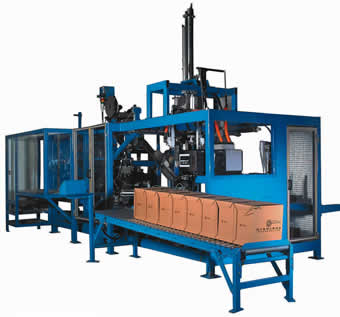
Maximum output and efficiency can be obtained by using a completely automatic REELEX coiling and boxing machine. This machine can be used off line with a motorised pay-off, or on line with an extruder. In either case, it will continuously wind coils, insert pay-out tubes, and fold boxes around the coils, thereby continuously producing finished packages. In this case, there is no need for a machine operator and outputs of up to 60 coils per hour are achieved without the cost of, and breaks required by, a machine operator. This machine is designed for manufacturers who have longer production runs and do not need to change coil and box sizes frequently. Windings has designated this as its Model D-2000.
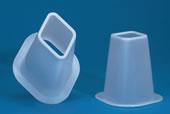
The D-2000 is a complex yet completely reliable piece of equipment that can be counted on to produce REELEX II coils continuously, 24 hours per day. Since it is designed to run without the attention of an operator, there are many self-diagnostics and self-adjusting algorithms built into the software that runs the machine. For example, if the machine is being run in a rewind situation, the D-2000 will learn and adjust the acceleration and deceleration times of the pay-off reel as it becomes lighter so that maximum efficiency is achieved. Should a malfunction or misfeed occur, the diagnostic screen will identify the problem to be attended to. Production personnel have the option at set up time to leave an occasional box open for inspection and/or testing, or can randomly select such a box at the push of a button. The machine can easily be interfaced with an on line printer to have sequential printing and proper cut-overs for each box. To maintain the integrity of the hole in the coil wall and guide the cable The D-2000 is the new world standard in reel-less packaging machinery. Every REELEX coil needs a guide tube (see Figure 8), usually made of plastic, to maintain the integrity of the hole in the coil wall and guide the cable from the inside of the coil to its exit from the coil. Until 1999, all REELEX coils used a 3/4-inch diameter guide tube.
However, manufacturers of communications cables began modifying their cable production processes to increase data transmission rates, usually by shortening lay lengths on the pairing and overall cabling operations used to manufacture theses types of cables. Theses shorter lay lengths, of varying lengths, had the effect of building in a slight pig-tail effect that could be seen even when the cable was lying on a flat surface. This residual twist, due to the manufacturing process, inhibited the ability of cable to exit REELEX coils through the 3/4 diameter guide tube. A popular and effective system REELEX II coils work equally well with copper and fibre based cables. The gentle handling of the cable during pay-out and installation lets end users know that electrical properties of the installed cable will be just as good as when the cable left the factory. Installers know that they can count on the benefits of using REELEX and REELEX II packages during their installation process. REELEX and REELEX II are packages designed for all types of wire and cables with a well-deserved superior reputation for past performance and they are packages promising superior performance for the future. Conclusion Windings markets the REELEX® system through the somewhat unique method of a License Agreement. Since many aspects of the System are protected by Patents throughout the world, each user of the system signs a License Agreement with Windings, allowing the customer access to and use of the Patents and know-how supplies by Windings. The License Agreement provides many benefits to the licensee such as low purchase price of machinery, guaranteed machine buy-back, guaranteed equality of pricing, access to all future patents and improvements, full and complete service support from Windings, and access to the ever-growing market for REELEX packaged products.
|
||||||||||||
|
||||||||||||