Introduction
In 1914, when metal heating in Europe was still by means
of coal, a young Swiss electrical engineer set about applying
a discovery made during a four-year learning experience in
the United States: resistance welding technology. Within
two years, Hans A. Schlatter had set up a company that has
gone on to inaugurate a series of innovative, cleaner, and
increasingly more energy-, time-, and cost-efficient manufacturing
processes, each adapted to contemporary needs. Now in its
89th year, H.A. Schlatter AG is an ISO-9001 certified market
leader and exporter of state-of-the-art resistance welding
plants. Its versatile product range has found customers in
a number of markets including railway construction, automotive
components, radiators, and wire products.
About electric resistance welding
Electric resistance welding is a versatile and highly dynamic
joining method able to perform a large number of welds quickly,
precisely, cleanly, economically, and with reproducible quality.
The process connects metal parts in a material-locked joint
by means of electric power to heat them to welding temperature
while subjecting them simultaneously to a mechanical force.
No filler material is used.
In a resistance welding machine, the parts must be fed to
the welding station exactly and positioned precisely; welding
current has to be controlled; and the process parameters
- current flow, current intensity, welding time, and welding
pressure - must all be controlled exactly. This requires
optimum coordination of the system’s mechanics, electronics,
and information technology by the machine builder. The Schlatter
term for this is “mechatronics”, and it forms
the basis of the company’s systems engineering, notably
the development of complete solutions in which several individual
machines work together in synchrony. The core expertise of
H.A. Schlatter AG lies in the synergistic coordination of
welding technology, mechatronics, and systems engineering.
A brief history
Today, two generations further on, the Schlatter family
firm maintains its awareness of the needs of the day and
strives to provide flexible and economical solutions to the
challenges of closely controlled productivity. Schlatter
was among those leading the advance from the inefficiency
of coal into the age of the electric current-heated forge,
developing heating machines for the production of shoe nails,
screws, and pointing wire rod, and spot welding machines
for the manufacture of products from light bulbs to 15mm
thick steel sheet. In the aftermath of World War II came
the major breakthrough that launched Schlatter on its core
process today: crosswire welding.
The European construction sector had largely opted to rebuild
devastated cities and structures using reinforced concrete.
But the steel reinforcement bars of the time were still manually
held in position and attached to one another with wire before
being embedded. Hans Schlatter, having devised a method of
welding a crosswire to hold these bars together, produced
his first mesh welding machine. Initially, only pairs of
line wires could be welded one by one with a single crosswire,
and output was low. This led Schlatter to develop a pneumatically
driven mesh welding machine integrating several transformers.
This permits all line wires to be welded at once over the
entire mesh width with one crosswire, an advance cylinder
moving the mesh into subsequent welding positions.
Schlatter’s headquarters in Schlieren, Switzerland
Welding quality and manufacturing productivity were thereby
much improved. Further developments such as double track
mesh welding followed, forerunners to the modern, fully automatic
turnkey production lines available today. These make welded
mesh for all kinds of wire products: supermarket trolleys;
shelves and racks for kitchen refrigerators and dishwashers;
display racks; animal cages; livestock transport containers;
reinforcement mesh for buildings and sound barriers along
motorways, roads, and tunnels; riverbank and coastal gabions,
and so on. The list is virtually endless.
The Posiweld system
Wire products, often shaped in three dimensions, are joined
together by the electric resistance spot-welding method using
the Schlatter Posiweld system, a flexible, reliable method
of welding cells for frequent-lot production with process
security for reproducible quality. With this system, bright,
stainless, and galvanised steel wires can be processed. Wire
products are manufactured in small, medium, and large series.
Typical examples include roundmesh, three-dimensional wire
articles, composite products, conical mesh, and special shapes.
Welding is performed on an assortment of wire diameters,
multi-layer composites, and close-netted mesh.
Posiweld system, type Orion
The Posiweld system features DC or low-frequency technique,
mains voltage compensation, and state-of-the-art welding
processor technology, offering constant parameters over the
entire welding range. Nonrectangular wire positions, different
diameters, or a combination of wire with tube or sheet metal
materials in one work cycle are also possible. Typical products
include storage baskets and shelves for home, office, and
industry; merchandise stands and racks; bird and pet cages;
griddles for cooking appliances; shopping trolleys and baskets;
mesh crates and containers; shelf inserts for refrigerators
and freezers, stainless mesh shelving; baskets for the food
industry; decorative mesh; fan screens; and washing baskets.
An outstanding feature of the Posiweld system is its excellent
welding quality for wire and sheet metal joints. AC, DC,
or medium-frequency power sources can be installed. Several
independent welding circuits can be incorporated in the same
cell if required. The Posiweld system also offers high output,
good operational reliability, and short changeover times.
Posiweld system, type Libra
Modular system concepts for industrial and reinforcing meshes
In road and tunnel construction and many building and civil
engineering sectors, reinforcing mesh of cold or hot rolled
wire is the usual choice, together with lattice beams and
all types of three-dimensional reinforcement. These wire
products are virtually indispensable for making not only
foundations, ceilings, pillars, and columns, but also prefabricated
concrete elements. Industrial mesh also sees service in such
other applications as shop fittings, storage facilities,
and household appliances. Most of these involve the use of
flat mesh. Shopping trolleys, shopping baskets, display stands,
shelves and mesh partitions in refrigerators, ovens and dishwashers
are just some typical products made of welded wire.
Reinforcement mesh
Welding machines of the Posiweld system are normally chosen
for the manufacture of round, three-dimensional, and multi-part
mesh products. Other machines are preferred for flat mesh.
The Schlatter MG series of mesh welding machines, including
versions MG900, MG300, and MG200, is of modular design and
available in various sizes. These machines are computer controlled
and can be interlinked with an assortment of loading, feeding,
straightening, cutting-to-length, and payoff units in an
automatic production line. Wires can be welded crosswise,
one on top of the other, in practically any arrangement.
Exact, reproducible control of the electric current and force
system according to amplitude and time is assured by the
SWEP welding process control system, together with stabilization
of network and voltage fluctuations. Mesh sheet geometry
is entered at a process control system and can be checked
on-screen. Using the parameters entered for the mesh width
and wire sizes, the system calculates the individual welding
values for each node, permitting the saved data to be called
up and edited at any time. Central data input and monitoring
are also possible, and the user-friendly features are rounded
off by electronic diagnosis and production data acquisition
systems.
The MG900 line for heavy industrial mesh
The MG 900 concept accommodates a wide array of uses for
industrial mesh, extending from filigree birdcages to heavy-duty
security fences with double-welded crosswires. This top-of-the-range
industrial mesh welding line system can be used for small-batch
or mass production of flat and very accurate mesh sheets,
and accepts any length of bright steel, galvanised, antimagnetic,
or stainless steel wire, of different line and crosswire
diameters.
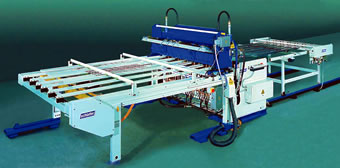
The system MG 900 for the manufacture of industrial wire
mesh and wire products
Gap or disc-type feeders equipped with preloading devices
or twin-gap feeders can automatically feed the crosswires
at varying pre-set speed sequences in any one loading cycle.
Mesh sheet is transported and positioned by the pneumatically
operated gripping fingers of the linear mesh pull-out units
or crank drives.
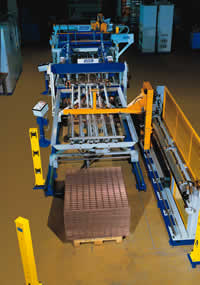
The system MG 900: a modular concept
Cutting heads are available for trimming and slitting with
programmable cutting positions and angles for a clean, accurate
cut on each individual crosswire and along line wires. The
special-design SYROCUT straightening and cutting unit allows
quick changeover to other wire diameters.
SYROCUT straightening and cutting unit
Rotating straightening elements and any of a whole range
of optional components (transformers, electrode holders,
single-spot and series simplex, duplex, or triplex weld presses)
can be fitted to suit particular weld applications. Electrodes,
electrode holders, thyristors, current cables, and transformers
will last much longer due to the system’s integrated
water cooling circuit. Efficient throughput without interrupted
production is achieved by stacking units set up in a line,
and automatic stacking devices for transferring the mesh
sheets into different storage areas. The number of mesh sheets
per stack can also be programmed in.
Conical mesh welding device to manufacture shopping carts
Crosswire bending unit directly integrated into the welding
machine
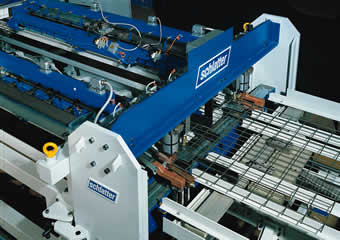
Welding station to weld additional line wires onto the
same base mesh
The MG 900 system is available with a large selection of
accessories for the manufacture of a multiplicity of specialty
products. A bending device for the production of column reinforcements
is just one example.
The MG 300 system for large-batch production
Models of the MG 300 system will process wire drawn from
coil or spool and straightened on the production line. This
system is recommended for production of large batches in
minimum time and with little manpower.
The Schlatter system MG for economical production of standard
mesh
The MG 300 system can be used for medium and large batches
or mass production of lightweight and heavy materials. Line
wires are fed from the coil, and the crosswire from a rotary
straightening unit with two integrated Syrocut straightening
and cutting-to-length units. The MG 300 is capable of producing
various dimensions without interruption.
System MG 303 for highly efficient production of medium-size
batches
The MG 300 series is modular and readily expanded. It incorporates
the MG 303 system featuring a disc-type feeder for the crosswires
that allows for quick changeover to other wire diameters.
The freely programmable roller advance unit contributes importantly
to the excellent flexibility. The MG 303 system is thus a
highly efficient production line, particularly for medium-size
batches. This series also incorporates the MG 316 system,
featuring a modular, extendible design that enables the mesh
producer to adapt to changing market conditions at any time
and at low cost. The possibility of combining crosswire feeding
both off-spool and off-magazine opens up new market opportunities.
In addition, the double-row MG 320 welding line operates
reliably and accessibly even at high production speeds and
in multi-shift operation.
Close-up of system MG 320
The MG 220 system for engineering welded wire fabric
The MG 200 system is suitable for the production of engineered
structural mesh. Models in the series process cut-to-length
line and crosswires. Various degrees of automation are available.
High flexibility and short resetting times offer the competitive
advantage of just-in-time production for direct delivery
to the building site. The system’s quick changeover
capabilities and high output of top quality welded wire fabric
commend it to the manufacturer. It ensures economic production
even with batch sizes of only one mesh sheet per order. The
most elaborate design of engineered welded wire fabric can
be produced fast and efficiently.
System MG 220 for small and medium batch production of
medium to heavy mesh panels, cold and hot rolled material
The MG 220 system is available in various designs and degrees
of automatisation, from manual to fully automatic. It features:
- Processing of hot rolled and cold rolled material;
- Laterally
stepless adjustable welding elements;
- Very large working
range;
- Floating welding presses;
- Central, user-friendly input
of production data through a process control system (PCS)
with a management
information system (MIS).
In the fully automatic version of the MG 220 system, prior
to shifting of the elements the computer automatically determines
their position and then calculates the shortest possible
drive track. Changeover times are minimised as the welding
heads do not have to be moved into a lateral initial position.
Finally, the computer verifies the actual location of the
repositioned elements, guaranteeing that even the first wire
fabric produced fully meets specifications. Able to process
line wires up to 26mm Ø and crosswires up to 16mm Ø,
the MG 220 system covers a much broader working range than
many other production lines. Mesh sheets can be produced
in any desired width up to 3,6m and in lengths up to 13,7m.
The system even handles sheets with displaced single- or
double-line wires.
System MG 230
Process control
From very early on, H.A. Schlatter AG realised that a good
machine can only become a leading product if it can offer
good process control. The company has always been committed
to in-house development of its controls, from electromagnetic
relays to electronics. Now, in the age of mechatronics, Schlatter’s
SWEP weld microprocessor control ensures reproducible, precise
regulation of current, force, and time values. Mains voltage
and frequency fluctuations are stabilised. And optimum linear
phase shifting of the individual transformers allows constant,
environment- and operator-friendly welding for excellent
surface quality and strong, quality joints free of spatter
and distortion. A central PCS data input facility offers
diagnostic features, monitoring production and locating errors
and interruptions, with all electronic variables stored in
memory for instant recall on demand. CNC-axis controllers
with AC servo-drives allow free and accurate programming
to within one-tenth of a millimetre.
Meeting the individual need
H.A. Schlatter AG is a successful plant designer and developer
with special skills in systems engineering, project management,
and quality control, supported by a highly qualified team
of experts. The company offers simple plant layout options,
a compatible unit construction system, and modular software
packages for extending or modifying existing production lines.
Schlatter’s test floor for machines and plants
A variety of machine widths is available. Components such
as weld presses, electrode holders, and magnets are equipped
with quick-clamping elements and plug connections for rapid
exchange and adjustment. Components and equipment can be
adjusted to accommodate initial investment outlays, while
allowing for possible future extension.
The Megaflex System
|



