TECHNICAL ARTICLE:
| The Dry-Silane Process for Crosslinking Low-Voltage Cable | ||||||||||||
| By: Rosendahl Maschinen GmbH, Austria | ||||||||||||
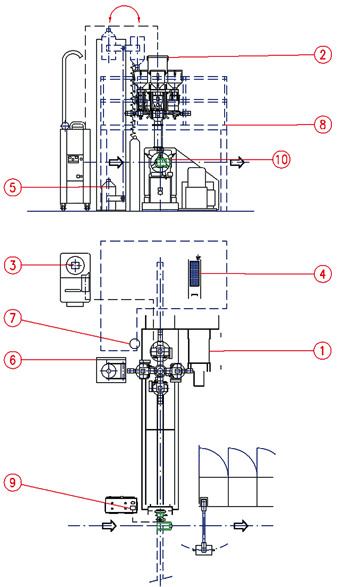
Introduction The Austrian company Rosendahl has recently developed equipment utilising “dry-silane” extrusion technology for the manufacture of low-voltage products. A typical dry-silane processing unit for low-voltage power cable production consists of these elements (Figure 1):
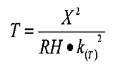
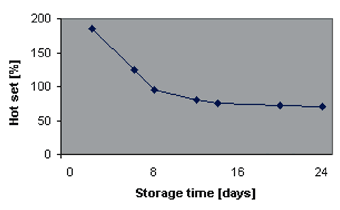
Raw Materials Base polymer Dry-silane masterbatch Antioxidant masterbatch Colour masterbatch UV-stabiliser Raw material preparation Because dry-silane masterbatches are sensitive to humidity, dry components have to be used. Pre-drying of the base polymer to a water content below 600ppm is necessary. Polymer transport from the dryer to the dosing station must be carried out using desiccant air from the drying system. The dry-silane masterbatch is never dried. Rosendahl takes special care with its extrusion lines to make sure that, within the line, dry-silane masterbatches are in contact only with silane-resistant materials. Handling the dry-silane masterbatch Shelf-life of the dry-silane masterbatch is approximately six month. Once the steel drum is opened, the dry-silane masterbatch should be used immediately. Storage of the steel drum must be in cool, dry conditions. Temperatures above 55°C have to be avoided during transport to the storage warehouse. When the steel drum is opened the cover has to be replaced by the conical adapter containing the outlet slide, level sensor, and nitrogen inlet. The steel drum with the conical adapter is lifted by means of the loading system (Figure 1, Item 6) to the top of the dosing system. During the lifting movement, the drum is also pivoted. When the working position is reached, the nitrogen supply and the level sensor have to be connected. After opening of the slide of the conical adapter, the dry-silane masterbatch can flow into the storage cylinder of the dosing system. During this process, the dry-silane masterbatch is well protected by a nitrogen blanket. Dosing system A gravimetric dosing system is absolutely necessary for dry-silane masterbatches with high-silane loading. For masterbatches with low-silane loading, a volumetric system could be used. However, Rosendahl strongly recommends a gravimetric system for these masterbatches, as well. Loss-in weight systems and batch systems may also be used. Extruder For applications in which dry-silane as well as PVC compounds have to be processed, Rosendahl utilises electrically heated/air-cooled 24D extruders. Typical output figures of a 120mm 24D machine are 270kg/hour XLPE and 800kg/hour PVC (with individual screws). For applications in which dry-silane only is to be processed, the company uses 30D machines. The XLPE output of a 120mm 30D extruder is approximately 300kg/hour. In general, for dry-silane applications Rosendahl uses shallow-grooved feeding zones in combinations with barrier-type screws. Separate screws for PVC and dry-silane are provided. The PVC screw has a standard compression rate, while a more moderate compression rate is used for dry-silane. For PVC, standard nitrited screws are used. Dry-silane XLPE requires screws with a special surface treatment. Screw heating/cooling A high-performance screw cooling system is essential. Typically, cooling capacities of approximately 50kW are used for a 120mm main extruder. The company uses water-based units because of their higher operational dynamic as compared with oil-based units. Crosshead For insulation applications on smaller cross-sections, usually fixed-centred crossheads are used. Compression tooling is used for round conductors. It is important that the parallel zone on the extrusion tools be kept short. Best results have been achieved with a maximum 4mm parallel length. Manually centred crossheads are commonly used for insulation applications on larger cross-sections. Sector-shaped conductors are processed by means of tubing tools. Die heating system For improving surface quality and to reduce unwanted die-related effects, a powerful die heating system is provided. The die heating temperature has to be in the range of 300-320°C. Open-flame burners are commonly used for this application. Alternatively, hot air blowers can be used. However, hot air systems have a lower operating temperature. Cooling trough The use of a hot water section after the crosshead operation is essential. The cooling water temperature in this section is in the range 60-80°C. Crosslinking To arrive at an estimate of the crosslinking time (Figure 2), the following formula can be used:
Where: K(95°C)=1,2.10-4 K(90°C)=1,0.10-4
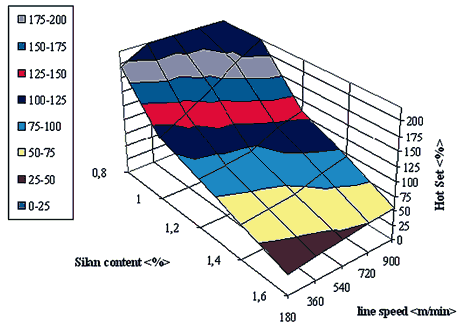
Hot set test The achievable hot set values depend on the absolute silane dosing rate. Figure 3 shows the relation between hot set values, absolute silane concentration, and line speed. The data shown have been collected on the basis of a 1,5mm2 insulated conductor.
Summary The dry-silane process offers significant advantages over other crosslinking methods for low-voltage cables. Dry-silane technology may be considered state-of-the-art for this specific cable type. By adding dry-silane process technology to its well-established ROSIL Liquid-Silane technology, Rosendahl has considerably broadened its capability in power cable extrusion equipment.
|
||||||||||||
|
||||||||||||