Background
Prior to the 1970s, most copper rod was produced by a batch process involving casting of wire bars, hot rolling, pickling and butt welding to form longer lengths. In the thirty subsequent years, this traditional process has been progressively superseded by continuous billet casting and hot rolling by the familiar Contirod, Properzi and Southwire processes, as the accepted means to produce electrolytic tough pitch copper (Cu-ETP) rod. With good process control and careful grading of coils during the production run, the best quality Cu-ETP rod has conductivity characteristics in excess of 101% IACS and is capable of being drawn to superfine wire with an acceptable rod-break performance. Characteristically, these are however big plants in the output range 50,000 to 200,000 tonnes per year, which must be run close to capacity to be economically viable.
Electrolytic tough pitch - Cu-ETP
Cu-ETP has a minimum copper content of 99.90%. Oxygen is intentionally alloyed with the copper in production of Cu-ETP and is controlled to around 200-400ppm. The oxygen acts as a scavenger for dissolved hydrogen and sulphur and will react also with most other impurities, to form insoluble oxides at the grain boundaries. This prevents these from dissolving in the copper matrix and adversely affecting conductivity and annealability of the rod and drawn wire. Conversely, however, the presence of occluded oxides in the copper wire rod, while solving one problem, can lead directly to another, as oxides tend to form hard particles and lead to wire breaks in fine wire drawing.
Oxygen-free high conductivity - Cu-OF
Cu-OF and its sister material Cu-OFE have minimum copper contents of 99.95% and 99.99% respectively. Alongside the advancing technology of Cu-ETP rod production, other companies developed processes for production of Cu-OF rod. Characteristically, these types of plant are smaller than the well-known Cu-ETP plants, with outputs in the range 2,000 to 30,000 tonnes per year, implying a significantly lower investment. As the name of the material suggests, there is little or almost no oxygen present in the redraw rod. There is thus little or no oxygen to react with impurities which may be in the copper and to avoid these becoming dissolved in the matrix of the copper. Production of oxygen-free copper is thus more demanding of the quality of the in-going cathode feedstock used in the process. Conversely, there will be little or no formation of oxides along the grain boundaries which, as mentioned earlier, is often a cause of wire breaks later on.
Unlike Cu-ETP, which is cast as a billet and hot rolled, a modern oxygen-free copper plant is generally designed to cast directly at 8mm diameter, as the accepted input size for wire breakdown throughout the world. In terms of performance in subsequent wire drawing, it is significant that rolling is eliminated as a process stage.
Why oxygen-free ?
The question is often asked "Why oxygen-free copper ?" "What are the benefits ?" "Who needs it ?" The facts are that by comparison to Cu-ETP, the market for Cu-OF is relatively small, but it is growing. Cu-OF will serve any of the purposes fulfilled by Cu-ETP, but has some additional properties of importance in particular applications.
The absence of occluded oxides at the grain boundaries in Cu-OF results in a more ductile material. This can be important in such applications as in aerospace, automotive wiring harnesses, robot arms and other similar applications, where the copper conductor core of a wire or cable is subjected to repeated flexing. The same characteristic of Cu-OF produces less "noise" and is thus of increasing interest in such applications as high quality sound recording systems and in headphones for both military and civilian use. The elimination of the risk of hydrogen embrittlement in copper through the use of Cu-OF is an important characteristic in welding applications. Creep resistance of Cu-OF is also superior, which favours its use in such applications as trolley wire. Another important market trend which is favouring Cu-OF is the explosive growth of the market for electronic devices and the progressive miniaturisation of electronic components. This has resulted in a demand for ever finer wire gauges, where now wires of 0.050mm diameter are not unusual. Demand is increasing for wires of 0.030mm diameter and less. Fine wires are now being regularly drawn on multi-wire machines with up to 32 strands. Wire break performance is critical to production efficiency. The purity of the metal and the absence of oxide particles in the structure become matters of serious concern. Here too, Cu-OF has distinct advantages over Cu-ETP. In production, the cast material exits the casting die and cooler assembly at around 80°C, well below the surface oxidation temperature. Cu-OF thus has a very thin layer of surface oxides, significantly less than Cu-ETP. The product thus lends itself to production of fine magnet wire and as a feedstock for continuous extrusion.
The plants are smaller and more versatile than the characteristic large Cu-ETP plants. Alloyed coppers can be produced, such as Cu-Ag, which is often used in commutator section of electric motors on account of its higher softening temperatures; CuSn, CuCd and CuMg as trolley wire alloys. Changeover is relatively simple and downtime minimized. Rods of different sizes can be made simultaneously. Investment is much less than for a typical casting and hot rolling plant to produce Cu-ETP.
Model RS 3000/8/8 copper rod casting machine - 6,000t./year |
|
Wire breaks in drawing
More and more attention is now being given to the causes of wire breaks in drawing, as with miniaturisation of electronic components, demand for finer and finer wires increases. The use of multiwire drawing machines, processing up to 32 strands simultaneously greatly increases the efficiency of the fine wire drawing process, but only so long as wire breaks can be routinely avoided. Conversely, the whole machine must be stopped and rethreaded when a wire break occurs.
It is common practice to divide wire breaks into two basic sources, from rod manufacturing and from wire drawing. It is not always a simple matter to identify the source, but it is important to study the process sequence as a whole. In reality, a wire break can be the result of a combination of the two sources. Detailed studies into wire breaks occurring in Cu-ETP in drawing to 0.05mm have been carried out recently in USA, involving examination and categorisation of over 2,500 wire break samples[1]. This work established that over 90% of all wire breaks were particle failures and that within this total, over 50% were ferrous inclusions and over 30% refractory inclusions. The dominant wire failure gauge occurs at around 0.1mm (38 AWG) and a defect particle size of 0.05mm seemed to be the statistical mean causing this. Using scanning electron microscopy, the principal elements causing wire breaks in descending order were found to be:
- Iron: 25.6%
- H-13 tool steel: 11.0%
- Silicon, aluminium: 9.5%
- Off-centre hollow: 8.3%
- Silicon: 7.6%
- Slag: .1%
Discussing these in sequence
Iron occurs in many continuous casting plants, as well as in wire drawing machines, making it difficult to identify the source. However, contact with ferrous materials in the Rautomead RS system is limited to the profiled withdrawal rolls and coiler rolls, both of which are made in specially hardened steel and very unlikely to contaminate the surface of the copper rod. No hot or cold rolling occurs and the rod is coiled on wooden pallets. Wire drawing is also a source of iron contamination, though in superfine wire drawing equipment, capstans are now often made in ceramic materials and guide pulleys and contact sheaves in plastic.
H-13 tool steel can generally be traced back to rod mill rolls and guides in the Cu-ETP plant and is likely to have been introduced in the hot rolling process stage. No rolling takes place in the Rautomead RS process for production of 8mm redraw rod, so that this source of wire breaks is eliminated.
Silicon & aluminium are typical refractory materials used in fabrication of conventional induction furnace linings and hot metal launders. It is a unique advantage of the Rautomead RS graphite furnace technology that graphite takes the place of fritted alumina ceramic furnace linings and is thus substantially reduced as a possible source of this major cause of wire breaks. More details of the graphite material and its properties are given below.
Off-centre hollows is a condition in Cu-ETP production, where a small particle of refractory is introduced into the molten metal flow, floating just below the surface as the metal solidifies. A skin of copper is created over the defect, which then ruptures in drawing. Again, the graphite furnace technology obviates this risk.
Silicon and slag can collect at the surface of the melt in a Cu-ETP plant and wash into the cast. The principal components are copper oxides, with the inclusion of silicon, aluminium and iron. Again, in the Rautomead RS process, the transfer from the melting chamber through to the casting chamber of the crucible is through the base, so that this risk does not arise.
The Rautomead RS Upwards Vertical Process
Rautomead has been building continuous casting machines based on the use of graphite furnace technology since the late 1970s. The technology was adapted to production of Cu-OF in the early 1990s, when the company saw an opportunity to improve on processes available at that time and particularly to use the naturally reducing characteristics of graphite to best advantage. The process uses a single furnace in which to melt, hold and cast the copper. This contrasts with other systems, which almost invariably use ceramic refractory lined, induction-heated furnaces, often positioned in tandem, one for melting and the second for casting, with the copper being poured from one to another.
Graphite
Characteristics which favour the use of graphite include the purity of this material as elemental graphitised carbon, its machinability, its thermal conductivity, its naturally reducing function, whereby oxygen present in the molten metal will react with the carbon and be eliminated from the melt and its excellent high temperature stability and strength. Graphite is not wetted by copper in the molten state.
A synthetic graphite is used, manufactured from carbon based materials, rather than the natural mined substance. Synthetic graphite is superior to the naturally occurring material, which can suffer from mechanical weakness associated with impurities and ash content. Under non-oxidising conditions, synthetic graphite is the highest temperature-stable elemental solid known. This is related to its high binding energy and its heat of sublimation. In manufacture, it involves powder processing technology on a large scale. Carbonaceous fillers are bonded with carbon-yielding binders, cured at around 1,500°C and sintered together at temperatures of the order of 3,000°C. In the process, the temperature of the baked carbon is gradually raised. Graphitisation commences at approximately 2,200°C. This process slowly transforms the baked carbon, a very hard, abrasive material with low thermal and electrical properties, into graphite, an allotropic modification of carbon, crystallising as hexagonal platelets. This material possesses excellent lubricity and high thermal and electrical conductivity.
The bulk filler material is carbon, carefully milled to a specific particle size and combined with an appropriate volume of binder. The binder used in the graphite industry is coal tar pitch, the product of destructive distillation of coking coal. The filler material is calcinated petroleum coke. The precise type and volume of filler, particle size and quantity of binder all have a marked influence on the density and final physical properties of the product. The aggregate mix is ground to a specific particle size and either moulded or extruded into "green" blocks. Vibration-moulded blocks are now preferred for large crucible manufacture, being more isotropic than extruded materials. High-quality die grade graphite is made by isostatic pressing.
Properties
The tensile strength and elastic modulus of graphite increase with increasing temperature, up to 2,400°C. Graphite exhibits very high thermal shock resistance - orders of magnitude higher than most high-temperature ceramic refractories. High-strength graphite with a bulk density of around 1.8 gm/cm3 has an open porosity of around 8%. Thermal conductivity in the casting die is very important in continuous casting and is the most significant property governing heat transfer. The grade of graphite commonly used in the fabrication of dies has a thermal conductivity value in the range 100-200 W/m K.
Reaction with liquid copper
Copper (together with tin, gold, silver and lead) is virtually inert relative to graphite at the temperatures necessary for continuous casting. Investigation has shown that the solubility in wt. % C, is about 0.0001 at 1,100°C, 0.00015 at 1,300°C, 0.0005 at 1,500°C, and 0.003 at 1,700°C.[2] As carbon does not diffuse through solid copper, solubility is exceedingly small.[3] Claims that the copper processed in the Rautomead system can somehow become contaminated by carbon can thus be easily dismissed.
| Graphite crucibles
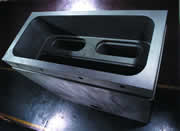
Crucibles are machined from solid blocks of vibration moulded graphite. In the case of integrated plants for the one-step conversion of copper cathode plates to Cu-OF redraw rod, these crucibles are of a twin-chamber design, where the cathodes are lowered and melted in a melt chamber, with a bottom port to a separate casting chamber. The significant mass represented by the heated crucible itself, forms part of the potential energy of the furnace design and contributes significantly to furnace temperature stability. |
Graphite Crucible |
The flow of molten copper is thus necessarily first-in-first-out and the design incorporates a graphite filter bed at the base of the casting chamber to ensure that the de-oxygenating process is complete, before the metal enters the casting dies at the top of the casting chamber.
A ceramic one-piece liner is fitted on top of the crucible to protect this from erosion through exposure to atmosphere and from physical abrasion. A layer of high purity graphite flake is used to protect the surface of the molten metal and an inert gas atmosphere is maintained inside the furnace to protect the graphite hot-working parts from erosion.
In other systems utilising separate induction melting and holding furnaces, a charcoal-based carbon-monoxide gas generator is often used to protect the molten metal from oxidation, as it is poured from one furnace to another. Moisture vapour entering such a gas generator from the atmosphere, particularly in areas of high humidity, is a major potential source of hydrogen in the melt and of consequent gas porosity in the rod. With no hot metal transfers taking place in the Rautomead system, this source of possible hydrogen gas inclusion is effectively eliminated. |
Finite element analysis crucible study
|
As furnaces have become larger, Rautomead has recently carried out extensive finite element analysis work in finalizing the design of graphite crucibles in association with the University of Strathclyde, Glasgow. This work has enabled performance at temperature to be carefully studied and any points of high stress in the design to be eliminated.
| Rautomead process design
A pick-and-place mechanism is used to lift the cathodes and to transfer them to a tilting table, which turns them to the vertical position, from where they are picked up and fed under control to the melting chamber of the graphite crucible.
The cathode passes through a layer of graphite flake, which acts as a hot metal cover and protects the surface of the molten copper from oxidation. The liquid copper sees only graphite contact surfaces. Crucible design is such that the copper must follow a first-in-first-out path, downwards to the transfer port and then upwards through a graphite filter arrangement to the casting dies. The casting dies themselves are immersed through the layer of graphite flake cover in the copper, where the metallostatic pressure created is used to channel the liquid copper into the die and cooler arrangement. LME grade A cathodes entering the process may be expected to contain about 60-80 ppm oxygen. This is reduced to 2-3 ppm in the process. No hot metal transfers between furnaces take place, thus avoiding the risk of hydrogen pick-up at that stage of the process.
|
|
Cathode Feed
|
Furnace heating is by electric resistance by means of a chain of graphite heating elements positioned adjacent to the wall of the graphite crucible, with the heat being transferred to the copper by radiation and convection. The This results in a still metal bath and an ideal condition from which to cast.
Casting is through water-cooled graphite casting inserts and backer inserts. Withdrawal is via two pairs of profiled nip rolls, using pneumatic pressure and rapid pulse indexing drive. Separate drives are provided for either side of the machine, making it easy to cast different sizes of rod simultaneously and selecting the casting speed best suited to each size.
Heating element chain |
|
Rod surface temperature at the cooler assembly exit point is less than 100°C. The rods are then fed over nylon support rollers and down to rod coilers via a dancing arm speed control station. The whole process is PLC controlled and is designed to monitor and manage all the major process variables without the need for human interference.
From this brief description, it will be clear that in the Rautomead process, there is no exposure to alumina or other types of frit ceramic furnace linings and no pouring of liquid metal from one furnace to another. On the other hand, a completely still metal bath is created from which to cast oxygen-free copper.
Rod withdrawal |
|
Cathode preheater
A recent innovation in some of Rautomead's copper rod casting machines has been to incorporate a cathode preheater. This is part of the cathode feed system and operates on the principle of an electric toaster, whereby each cathode is lowered into an electrically powered preheat furnace and heated to approximately 200°C before being fed to the furnace.
The effect of the cathode preheater is to dry off any surface moisture, condensation or surface-trapped electrolyte and thus to ensure that hydrogen from those possible sources is eliminated. It avoids metal splashing at the feed point and contributes to the overall melting burden of the furnace itself.
Line sketch of cathode preheater |
|
Improved temperature control
Maintenance of stable production parameters is one of the most important criteria for production of good and consistent quality copper redraw rod. Among these parameters, none is more important than stable control of temperature at the point of casting. In the Rautomead process, operating temperature is measured by two thermocouples, one of which is immersed in the molten metal, close to the casting dies and the other in the furnace, in close proximity to the crucible wall. Using a cascade temperature control arrangement, this enables a tolerance of ±3°C to be automatically maintained at the casting dies.
Temperature trace
High-speed rod casting
When the RS upwards vertical casting process for 8mm Cu-OF rod was developed in the early 1990s, the target casting speed was 3.0m/min, to give 80kg/per strand per hour. This balanced with a melting capability of around 700kg/per hour for the machine in an eight strand configuration. Recently, improvements in rod cooler design and in mechanical withdrawal have permitted increases in casting speed to 5m per minute. An eight strand machine today is now rated at 500 KVA and is capable of over 1,000 kg per hour.
Feedstock and impurities
This paper would be incomplete without a section on the selection of feedstock. Except in the removal of oxygen, the Rautomead Cu-OF process is not a refining one. Thus, the quality and cleanliness of the feedstock used is of critical importance in production of good quality copper redraw rod. The specification set by Rautomead calls for the use of LME grade A cathode (Cu-CATH-1). Impurities generally enter the production chain at source. Cu-CATH-1 specification is, however, relatively broad and permits the presence many of the elements which can be deleterious in wire drawing. Maximum impurities permitted are 0.0065%, although most cathodes produced have significantly lower impurities at around 0.002%. Therefore, it is not sufficiently precise for the user to specify grade A cathode, as the feedstock. Rather, a more detailed appraisal of both nominal composition and of manufacturing consistency must be made in the selection of suitable cathode feedstock.
Composition -
cathode and wire rod
Within the total allowable level, individual impurities or groups of impurities may also be close to the maximum permitted individual or group levels.
Composition is influenced by the mining source of the copper ore and by the technology of the refinery where the cathode is produced. The most critical impurities in relation to wire drawing, graded as to their influence on wire breaks are as follows:
- Severe effect: Bi Te Se (cause grain boundary cracks)
- Deleterious: Pb As Sb S (cause grain boundary cracks)
- Low effect: Cr Fe Sn P Si Ag (affect annealability)
Hydrogen also accentuates the detrimental effect of other impurities which may be present at grain boundaries. Care must be taken to eliminate as many sources of hydrogen ion from the process as possible. Cathode selection and handling, furnace atmosphere, as well as melt surface protection, must all be carefully regulated to minimize hydrogen pick-up. |
|
|
Procedures for testing cathode for impurities during production vary between cathode producers. Some take 20mm diameter samples either from each or from a proportion of cathodes. The samples are melted and analysed.
However, chemical composition is recognised as not necessarily consistent over the full area of a cathode. A true representative analysis requires a full cathode to be melted. As this is rarely done, quoted chemical compositions of cathode should be treated with caution. There is no substitute for taking rod samples after casting. This takes into account any mixing of cathode during the process. |
Hydrogen levels in molten copper are easily raised where oxygen levels are low. The presence of hydrogen may create voids in the matrix structure, which may close down or may propagate during wire drawing. It is important that dry cathode is charged into any of the production process. A further source of hydrogen may be from the electrolytic deposition process used in cathode production. Electrolyte can become trapped in the cathode and enter the melt. The electrolyte contains thiourea and glue, both of which are high in hydrogen ions. Cathodes should be selected which have been shown to have low levels of trapped electrolyte and should be stored ready for use in a dry environment. Care must be taken to avoid surface condensation on cathodes exposed to changes in atmospheric temperature and humidity before use.
Summary
It can thus be shown that both in the selection of materials and in the process design, the Rautomead RS upwards vertical casting process effectively prevents many of the common rod manufacturing-related sources of wire breaks and offers users real advantages in processing to fine and superfine wire. It does not however eliminate the need for careful selection of feedstock cathode and similar detailed attention to all stage of the wire drawing process. The benefits of this rod production technology will play an increasingly important role in association with the adoption by wire and cable manufacturers of multi-wire drawing machines and enable them to obtain the best efficiency from these machines.
Acknowledgements
1] Masoud Garshasb and Timothy J Day, "Quality Enhancement of Ultrafine Magnet Wire utilizing Failure Analysis", Conference Proceedings of the Wire Association International's Wire & Cable Technical Symposium, 2001, pp 220-226.
2] M. B. Bever and C. F. Floe, Trans AIME, 166, 1946, 128-141
Solubility of Carbon in Copper
3] W. Baukloh and F. Springorum, Z. anorg. Chem., 230, 1937, 315-320
Solubility of Carbon in Copper
|