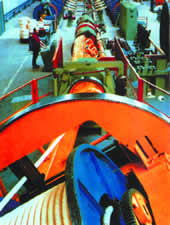
Some fifty years ago a smart idea…
from the ingenuity of Ilario Properzi (1897-1976), an Italian small lead and zinc rod manufacturer, gave birth to the continuous casting and direct rolling (CCR) of non-ferrous wire rod which enables in a two minutes single operation to pass directly from molten metal to rod. The introduction of the Properzi CCR technology deeply influenced the industrial development of energy transfer and communications world-wide during the second half of the 20th century. In recognition of this revolutionary invention, an early Properzi line is a permanent exhibit at the Leonardo da Vinci National Science and Technology Museum in Milan (Italy). |
Continuus-Properzi installed the very first line anywhere to produce CCR copper rod from cathodes in the early 60's. In the mid 80's the first Properzi line producing copper rod using 100% copper scrap as starting material was successfully put in operation, meeting the most stringent international quality standards. The Continuus-Properzi is the only company offering the world market the copper scrap process, in co-operation with La Farga Lacambra (Spain). Over the last years the Continuus put on the market different and most advanced technology machinery. To name only two: the non-ferrous ingots caster, the CCW line (Continuous Cast Wire) particularly suitable for production of mechanical aluminium alloys rod.
New division
The Continuus-Properzi brand names RTM (Italy) and OTT (France) stand for very experienced manufacturers of high-carbon steel wire transformation machinery. At the same time, the industry standard for stranding machinery and "jumbo" closers has been set by J.A. Kraft, Germany, also a part of the group. These three wire and cable machinery manufacturers now serve as a world-wide single-source supplier to both ferrous and non-ferrous wire and wire rope manufacturers. The Wire Machinery Division (WMD) was established in 1999. |
Partial view of the Continuus-Properzi factory in Milan, Italy
|
Production lines for PC wire
OTT wire drawing lines are designed specifically for dry-drawing of large diameter, high carbon steel rod with up to 0.85% carbon content and a rod inlet diameter of up to 17mm. These lines offer some important benefits, including a non-swirl flipper pay-off unit for continuous rod unwinding, and rod mechanical descaling using a pre-descaling straightener, followed by shot-blasting. Horizontal spoolers, suitable for DIN 350mm-1,600mm Ø bobbins, are equipped with adapters and lifting options for various applications.
Also included are LOGOS series drawing machines for high-carbon steel with sensor arm, featuring:
- 1,270mm, 900mm and 760mm Ø capstans for higher productivity;
- Horizontal and vertical axis versions;
- Low-deflection sensor arms for superior wire quality;
- Ease of maintenance;
- Reliable higher production rates;
- High-pressure Evo2 narrow-gap water cooling system.
Other options include a fully closed low carbonate water circuit with heat exchanger and pressure dies and rotating dies.
In terms of line productivity, various systems are available among which one system consisting of payoff, descaler, a LOGOS 900/7 drawing machine, and a DIN 1,400mm spooler, is able to produce 2.4 tons per hour of high carbon 5.5mm Ø steel wire based on 85% plant efficiency. The wire produced by this machine should feed the RTM PC wire line, resulting in a 5mm Ø drawn PC wire. A second system consists of payoff, descaler, a LOGOS 900/8 drawing machine, and a DIN 1,120mm spooler, and is able to produce 2.6 tons per hour of high carbon 4.11 mm Ø steel wire on the basis of 85% plant efficiency. This wire is the basic inlet wire for a 1/2-in. Ø RTM PC stranding line.
Continuus-Properzi provides a complete PC system that features not only state-of-the-art machinery but also the equally important operator training. The PC wire line, based on the concept of counter-reaction from a water-cooled die, simultaneously applies both tension and heat to the wire by means of an induction furnace and specially grooved and balanced capstan(s). The wire take-up features a continuous double-coiling system for transport-ready coils of 1.8m Ø and up to 1.5t weight. |
Low relaxation PC strand line
|
The PC line is available in two versions. The first has a single capstan for finished PC wire 3.0-6.0mm Ø. The double-capstan version is for finished PC wire 3.0-9.4mm Ø, and includes a movable induction furnace for wire recovery in case of line power outages. Both lines include indenting rolls, different options for power levels in the induction furnace, and PC-based collection and management of final production data.
Another RTM product, the tandem line for PC wire, feeds wire produced on a LOGOS series drawing machine directly into a PC wire line and packaging system. The end product is a ready-to-transport PC wire coil. A single operator controls the entire system from the steel rod stage to unloading of the finished wire coil.
When talking of PC strand line
The high speed of the bow-type SKIP strander, which makes up the PC strand seven-wire system, provides a superior surface on a high-quality strand that is fed in-line to the induction furnace and the cooling and drying units. The fifth generation of high-speed layer winders places the strand with precision spacing to assure a compact coil for ease of use and transport.
Lines can be customised to the application. For instance, the line can incorporate a skip strander using 900mm to 1,250mm Ø bobbins, each having a weight capacity of 1,250-3,500kg. Alternatively, lines can include heat treatment furnaces of 450kW to 800kW. Combinations can be configured to suit specific production mixes. PC strands can range from 1/4 in. standard to 0.7 in. super-compacted. The skip strander, a top-performance in 6+1 configuration, was developed by RTM in 1968. Since its introduction, 116 machines have been installed around the world. By a significant margin, RTM is the largest producer of SKIP machines in the world. Today's RTM SKIP strander is considered by the industry to be one of the best designs available.
The unit's features and options incorporate bobbin diameters which range from 250mm to 120mm, with over 16 models to choose from. The rotor bearings are automatically lubricated by means of a centralised lubricating system, while bearing temperature sensors stop the machine if overheating occurs. The pneumatic pintles have safety locks, and photocells monitor each cradle and will stop the machine in case of excessive oscillation. With operator-adjusted friction brakes (double set optional) located on each bobbin and featuring a quick-release lever, the machine has an impressive level of control. These control features are compounded by a sensor which monitors bobbin weight to reduce braking pressure. The structural footprint of the equipment is very flexible and can fulfil the most stringent production requirements. A skip strander with low-abrasion rotating roll guides has been developed and placed into service for the production of galvanised PC strand
The PC strand three-wire system is an easy-to-use, cost-effective line based on the same concept and design as those of the seven-wire PC strand line. The SKIP strander (2+1) is available with a 900mm bobbin, with finished strands collected in coil form and strapped according to customer requirement.
Finally, the PC strand 19-wire system is a tubular strander which combines a "jumbo" tubular strander with bobbins of 1,100mm Ø and an oversized in-line tensioning-heating system. This machine makes possible the production of PC 19-wire, 29mm Ø strands (Seale/Worrinton type construction). The highly efficient production system is four times faster than any other on the market for this specific application. |
Properzi copper CCR (Continuous Cast & Rolled) rod lines are in operation around the world
|
Advanced machines for production of steel wire and rope
More than 400 OTT wire drawing machines with "no slip" capability have been sold. These MEGA-LOGOS series machines have 760mm, 900mm and 1,270mm capstans, while the TMD series offers capstans of 280mm up to 670mm. Features and options include:
- No-swirl, flipper payoff unit for continuous unwinding;
- In-line rod mechanical descaling and surface treatment (optional);
- Self-centring sensor (a dancer arm on smaller machines), assuring co-ordination of the capstans;
- Sensorless design available on request;
- Capstan design of either horizontal or vertical axis;
- Capstan cooling by high-pressure Evo2 water-cooling system, plus a capstan apron ring cooled by a high-pressure air blower;
- Capstan service life of over thousands hours before possible regrinding which is a great advantage to users;
- Capstans made of minimal-thickness forged steel;
- Individual DC drives or AC inverters;
- Full-enclosure guards with an optional dust exhaust system, designed to meet ecological and sound level requirements;
- Computer-aided wire drawing system with analogue programmable controller and video display that can be integrated into the main control desk;
- Take-up systems of many types to meet customer specifications and needs.
| Skip strander
Wire guides on the bows are made of steel, zirconium, or tungsten carbide, depending on the application, and the pre-former heads are custom designed. Special versions have extended pitch between cradles for delicate handling of galvanised and non-ferrous wire to prevent surface damage. Also available are optional rollers that assure no surface damage occurs to strand-galvanised or non-ferrous wire. A hydraulically operated strand killer unit can also be supplied, with the option of electronic control of the haul-off unit speed. Standard computerised machine management, with recorded programmable recipes which allow for repeated accurate settings. Motorised tensioning of bobbin pay-off can be utilised for specific closing applications.
|
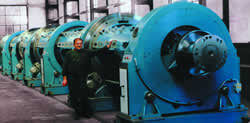
Tubular closer for 1,000mm Ø bobbins, showing the electronically adjustable back-twist mechanism on the cradles
|
Double twist strander
The SDT double-twist machine is considered by wire industry specialists to be one of the more specialised machines designed for bunching and stranding of high carbon steel wire. This machine differentiates itself from other double-twist bunchers in that the haul-off capstan is located before entry to the bow, thereby applying the tough stranding tension needed to make modern steel strands of up to 12mm Ø. The double-twist strander is able to handle from seven to 41 bobbins with one machine. The twisting condition of each type of wire strand can be selected by adjusting the over-twister and post-former. With adjustable tension, the machine also features an anti-twist device located before the stranding point. The speed of the rotating post-former can be increased by up to 20%, and an optional pre-twisting unit can be fitted. Take-up bobbin size ranges from 630mm to 1,250mm, and the loading/unloading action is by hydraulic elevation. The winding tension of double-twist take-up is adjustable from the control desk, and the take-up bobbin is driven by a DC/AC motor.
Tubular stranders and closers
The most recent generation of tubular machines, used for stranding and closing high quality steel wire, have been redesigned to include computer-controlled devices which monitor wire breaks, more efficient bearings and under-rollers, better lubricating systems, and higher speeds. This translates into improved reliability and increased productivity. The machines are comprised of balanced and stress-relieved tube. Variable back-twist devices and adjustable braking systems are also available for each cradle. Pre-former heads are interchangeable to allow stranding of a variety of different wire rope sizes and configurations. The following items are located on each tubular section:
- Rotors dynamically balanced for vibration-free operation;
- Tungsten carbide guides along the tube as well as at the deviation points;
- Rotor disk brakes;
- Bobbins supported on pneumatic or mechanical pintles and provided with safety locks;
- An anti-rocking system that stops the machine in case of excessive cradle oscillation;
- Operator-adjusted friction brakes (double on request) located on each bobbin, each featuring a quick-release lever;
- A variable back-twist device is available on larger machines;
- Models with extended pitch between cradles for variable closing and non-ferrous applications;
- Electronic control of separate capstan DC/AC motors to allow for multiple lay settings.
The Continuus tubular stranders offer bobbin sizes from DIN 200mm to 1,120mm Ø and with bobbin capacities ranging from six to 36.
| Planetary closers (cage type)
Planetary cage-closing machines are designed for the toughest jobs. The gigantic size of these machines is one of their most salient features. Built to customer specification, they utilise the principle of stranding/closing to limit twisting of the wire around its own axis. This principle requires maintaining bobbins on the same plane or a parallel axis as the cage turns.
|
The first "Jumbo" tubular PC strander CT110/18 installed in Japan
|
Production plants and machinery for power and telecommunication cables
J.A. Kraft offers a wide range of stranding and cable forming machines for a variety of non-ferrous applications. The SKIP strander for the cable industry features many configurations including the standard 1+6 wire stranding action, ease of use, and high-speed performance.
On the basis of its early-concept machinery and extensive testing, J.A. Kraft made a number of modifications and improvements to its machinery lines for the production of stranded non-ferrous wire. The range of products includes machinery capable of handling bobbins with diameter sizes from 500mm to 1,250mm. The larger diameters are also suitable for cable forming. These SKIP stranders are complete with soundproof protection guards, pre-formers and post-formers (compactor devices), lapping devices and single- or double-wheel hailoff units. Take-ups can be supplied as either cantilever or portal-type traversing machines, designed for precise lay control. The finished product from the SKIP machines is the perfect core for multi-layer strands applied by subsequent in-line cage stranders.
J.A. Kraft offers the ZSAK type strander as an alternative to the traditional rigid-cage stranding machine. Standard features include 6, 12, 18, and 24 bobbins per module, a module speed up to 600rpm, including the 24 bobbins, and tension control ensuring wire tension is constantly maintained by a central electronic device. The wire feed can be adapted to coils, bobbins, or bundles. With a dual-wheel capstan and low noise level, this machine has been developed for use with 710mm Ø bobbin capacity, per DIN standards.
As a division of Continuus-Properzi, J.A. Kraft is also involved in co-ordinated turnkey projects for the production of power and telephone cables. The company designs and fabricates a complete range of machinery for this segment of the industry, including payoffs, take-ups, capstans, drum twisters, and all kinds of special auxiliary equipment. The largest J.A. Kraft drum twister can accommodate a take-up/reel with flange diameter of 3,400mm. This assures the best quality in cable forming in combination with several pieces of ancillary equipment as well as armouring units, lapping units, extrusion heads and various types of filling equipment. |
|
|