TECHNICAL ARTICLE:
| More Flexibility for Small-Scale Rod Producers | ||||||||||
| By: Outokumpu Castform Oy, Finland | ||||||||||
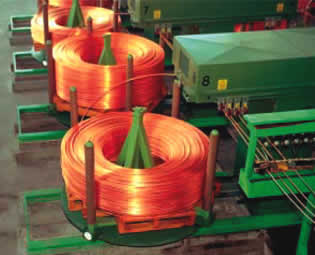
Introduction The Outokumpu UPCAST® is the original upward continuous casting system for oxygen-free copper and copper alloy wire rods, both for the small to medium capacity range. Originally invented and developed by the Finnish company Outokumpu Castform Oy more than three decades ago to serve the company’s own production needs, UPCAST® system is today the undisputed market leader with an impressive performance record covering over 140 installed units world-wide. A custom designed system The UPCAST® system is always custom designed (lay-out, capacity, rod diameter, etc.) according to customer requirements. The capacity range offered is up to 30,000 tonnes per year, while typical installations are between 5,000 to 25,000 tonnes per year. Typical cast rod diameter is 8mm, which matches the rod breakdown machine inlet dimension. Melting power is provided by means of induction and the casting machine is based on sophisticated servo drive technology. The system is highly automated and, depending on production capacity, requires 1-2 full or part time operators for running. UPCAST® is typically a two-furnace system incorporating separate melting and casting furnaces. The molten copper is intermittently transferred via launder from the melting to the casting furnace. This arrangement ensures most efficient oxygen removal from the copper and optimal temperature control - both key elements in achieving the highest-quality, oxygen-free, copper wire rod. Upgrading capacity Outokumpu has also developed a single-furnace system capable of producing smaller quantities, whilst maintaining the high-quality of UPCAST® produced rod. This system combines the melting and casting processes in one compact furnace and has been rated at up to 6,000 tonnes per year oxygen-free copper rod. A special feature of this single-furnace system is the possibility to expand it into a two-furnace system at a later stage, thereby increasing capacity from (for example) 6,000 to 12,000 tonnes per year by addition of a separate melting furnace and related equipment. The demand for small-scale rod production units has increased significantly during the recent years. Almost half of all UPCAST® units delivered after year 2000 have been single-furnace systems, but with provisions for future expansion. In fact, several customers have already ordered an upgrade to their production capacity and Outokumpu has retrofitted melting furnaces to these customers' units. Two such projects have been successfully commissioned in 2003 and the quick lead times to restart production with these expanded units has shown the Outokumpu “modular” concept to work extremely well. Compared to installing a second single-furnace unit of similar capacity and size, the savings in time, effort and money are significant.
New single-furnace unit Following the success of its single-furnace system, Outokumpu has made several design improvements and modifications, and has now launched a new version with increased melt holding capacity and an optimum production capacity of up to 8,000 tonnes per year (950kg per hour). In addition to increased capacity, special attention has been paid to the flexibility and easy expansion of the system into a larger capacity two-furnace unit.
Instead of using the current semi-automatic cathode handler, the new single-furnace systems can be equipped with an automatic cathode charging system originally designed and used only in larger capacity two-furnace systems. The benefits to this are that the capacity expansion at a later stage is more flexible as the charging system is already available at the plant. Also, the automatic charging system can be designed to hold a cathode storage for up to 24 hours production without need for refill, thus decreasing the need for operator involvement in production. Other design improvements The casting machine die cooler construction has also been redesigned to further improve rod quality and the ability to draw the product to finest sizes. Control of solidification and cooling of the rod are essential elements in ensuring best drawability of the rod. Fine wire and multi-wire drawing companies invariably accept only the best quality feed material into their wire mills.
Tests conducted at Outokumpu's own facilities and customer's wire plants have shown that the new die cooler design has increased the drawability of the wire rod produced with less breaks per tonne produced, while also improving the casting operation in terms of even higher reliability. New customers The market response to the above developments has been very good and the first contract to deliver a new version of the single-furnace unit based on the improvements outlined, has been signed with Cecil S/A, Brazil.
Delivery of this unit will take place by the end of 2003. A contract for the delivery of a similar high-capacity single-furnace unit was signed in August 2003, to another customer. |
||||||||||
|
||||||||||