TECHNICAL ARTICLE:
| Innovations in FEP Foam Production Leads to New C/D Control | ||||||||||||
| By: Pierre-Yves Bonvin, Product Manager, Maillefer SA, Switzerland | ||||||||||||
Introduction Efforts in the development of FEP grades combined with the design of Maillefer’s extrusion group have given rise to exciting opportunities in cable constructions. A new processing window has opened for the production of expanded FEP with thin wall layers. To help manufactures work reliably within the window, Maillefer has developed a Capacitance/Diameter regulation using cone length control (patent pending). The increasing acceptance of foam FEP wire types began a few years ago. LAN cables Cat 6 and Cat 7 left the laboratory for industrial production. They were driven by improved electrical characteristics at lower costs. In addition, micro-coax cables with a foam-skin construction easily penetrated the electronic market. They combine improved electrical properties with a reduced size. Improvements soon followed the first FEP foam line configurations. Today they are giving impressive results on the final cable quality. These multiple innovations include the following. ECH 3/9 FEP triple-layer extrusion head for skin-foam-skin FEP production Designed and assembled by Maillefer, this manual centering head has the flexibility of working with one or two auxiliary extruders for the inner and outer layers. The head separates one flow into two layers when working with an individual machine. For high level products, two auxiliary extruders can be used. In this case same head directly channels the individual layers from the two separate machines. The anti-corrosive Inconel head has three individual heating zones:
A special wire guide system is built into the vacuum pump connection for precise conductor centering. The head is designed for reduced maintenance and quick set-up times. It can be easily assembled and dismantled without special tools. Improved proprietary injection group The modified high-pressure gas injection group comfortably reaches the low injection rates required for the FEP foam process. The electro-valve, filters and high-resolution manometers are sized to provide a stable and uninterrupted supply of 0.8 liter per hour minimum. New water-cooled injector system High-temperatures and low outputs require special attention to injector design. The nozzle area can reach more than 200°C when working with FEP. Through the use of Maillefer’s water-cooled injectors, nozzle temperatures are brought down to an ideal operating temperature of less than 40°C. Stable outputs and long nozzle life are thus ensured. Avoiding dilation prevents leakage around the gem and mechanical strains on the nozzle. With the innovations described above and process tuning we were reaching high-quality levels thin wall production for Cat 6, Cat 7 cables and micro-coax wires. The next innovative step required efforts on improving process extrusion reliability and reducing scrap. Not only must these high-levels of quality be reached, but most importantly, they must be maintained throughout entire production.
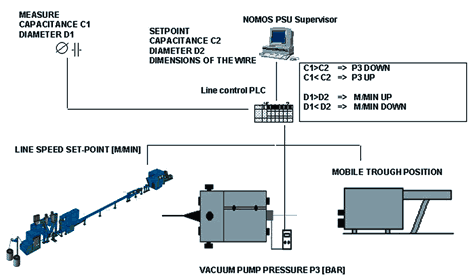
All components and process parameters were already fine-tuned the demanding requirements. Our attention was therefore brought upon the widely accepted model of C/D control. A traditional C/D control found on high-speed insulation lines has three control loops. Two loops control capacitance by acting on the mobile trough position and the flow of nitrogen to the extruder. The third loop controls diameter by adjustments on either extruder speed or line speed. These three control loops are interdependent. The closed loop system takes into account the modification of one parameter to correct another as outlined in the following:
During our study it became obvious that the standard C/D model was not well adapted to the FEP foam process. The limitations were shown to be:
We had also made the following observations:
A new development for C/D regulation of FEP foam was required. The idea was to take into account the use of tube style tooling for the production of expanded insulation. This meant linking expansion variations to cone length. Cone length would therefore become a new process parameter. New diameter control:
New capacitance control:
The feasibility of the new C/D control was demonstrated through a series of trials. The target was to characterise a new actuator to determine the correction window - capacitance variation versus cone length variation. The work done shows that cone length control influences capacitance and diameter without interfering with other wire parameters. If the system is used within defined limits, then parameters such as ovality, concentricity and adhesion are not altered by the use of the cone length control. When crossing these limits we could detect an effect on the concentricity and on the cell’s structure. The average cell’s size of 17µm for an expansion of 55% is doubled when exceeding the limit. The concentricity value drops radically. With the help of these observations on the quality of the wire, we could easily define the working range of the new C/D cone control. During the study to determine the limits of the process window, the following variables were modified:
and the following results were monitored:
From this sequence of trials, a model was built to extract the best working conditions for the new C/D control. This basis allowed us to determine the critical working point for a precise process parameter. Whether the priority parameter during wire production is capacitance stability or cell structure, the optimal cone length shall be different. The values mentioned above are the maximum correction variations we could reach without altering the minimum required quality of the wire. The correction window of 16 pf/m is wide enough to limit the cone’s length variation to less than ±10mm. The stability of the NMC 45-30D extruder does not require a correction value of more than ±5pf/m. An adjustment of just a few millimeters of cone length are sufficient to balance a capacitance variation due to temperature instability or a compound batch change. The correction limit is fixed in order to stay within the predetermined quality border. The large variations due to injection pressure in the extruder encouraged us to eliminate injection pressure from the new C/D control. The cone length control has a sufficient effect on the capacitance value without the disadvantage of latency time from injection pressure variation. When using injection pressure variation, the delay between the modification of the set point and the effect on the wire in relation to the extruder’s speed can reach 3 to 4 minutes. Cone length control has an immediate effect on the actual value of the capacitance. If a deviation is detected the algorithm immediately corrects the set-point value. As for the effect of cone length on the diameter, we also chose not to include it in the C/D control. Extruder speed and line speed variation as conventional actuators are sufficient. Maillefer recommends varying the line speed. Extrusion of FEP foam is a sensitive process. These tests have once again confirmed the fact that optimal extrusion conditions bring great benefit to final wire quality. This is why we opt for stable and optimal extruder output while choosing to modify line speed. However, the possibility does exist to link the diameter control to the extruder’s speed in the recipe system. This patented C/D control has been tested mainly with FEP resin. However, the concept is not limited to fluoro-polymers. We expect its use with most expanded layers that require tube tooling. The new C/D control using cone length equips all our fluoropolymer insulation lines having the Extrucell® process for high-pressure nitrogen injection. Maillefer currently has a patent pending for this new C/D concept, which applies to tube tooling extrusion. The innovation is well suited for applications such as LAN Cat 6 and Cat 7 and micro-coax cable. The reliability and the stability of capacitance are radically improved without altering other quality parameters. Conclusion Equipped with the new C/D control, the FEP foam process has come of age for mass production. Scrap reduction and tighter tolerances resulting from the robust and fine C/D control improves the productivity of insulation lines. Each minute of production saved increases manufacturer competitiveness. Having a properly adapted C/D control that responds quickly means faster start-ups to within tolerance and reduced risks of generating scrap during production runs. Maillefer is a recognized leader of manufacturing solutions for the extrusion of FEP foam multi-layer constructions. In addition to specially adapted components, the offering includes the expertise to reliably produce high quality wires. The C/D regulation with cone length is a key towards the industrialisation of this particular process.
|
||||||||||||
|
||||||||||||