TECHNICAL ARTICLE:
| Seven Dials Warehouse Fire - Survey of an Uncommon Fire | ||||||||
| By: David Townsend MIFireE, London Fire Brigade, UK | ||||||||
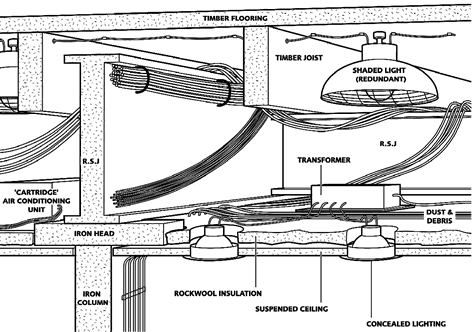
Introduction In Central London, it is a legal requirement for the first two fire appliances to reach the scene of a fire in only five minutes from the time of the first call. We achieve that over 95% of the time, therefore most of our fires are relatively small, confined to one room only. This fire burned through three floors over a wide area, requiring 20 fire appliances to control it and was not caused by arson or explosion there had to be an unusual factor involved. That factor was cables. Survey of the building The building had six floors and a basement and measured 25m by 60m tapering down to 8m. It was part of an island site the remainder of which comprised a major London Theatre and offices. It was built around 1890 as a brewery and paper warehouse. The construction was of solid brick walls with concrete flooring up to third floor level and wooden flooring above. Structural columns were of cast iron. Structural beams were of unprotected steel. The timber roof was close boarded and slated. It remained in warehouse use up to about 1960 when it was converted to offices and shops. The fire started on the third floor in an area known as “Unit 25”. A video editing/copying company occupied this unit. The main entrance opened onto a reception area with work desks beyond. To the south side was a “graphics” department using standard computer equipment. To the north side was a control room and editing suite. To the centre was a room known as the “Head End room”. In this room there were racks of video copying machines and associated equipment. These machines would run very hot. An electrical isolation switch was fitted near to the reception area that would shut down all power to this equipment but would leave most other circuits live. Normal routines in this suite could involve people working up to midnight but the last person to leave would operate the power isolation switch. None of the room partitions extended through the false ceiling to the structural floor above. This created a 0.5m ceiling void over the whole area (25m x 11m) in which was laid a considerable amount of communications, mains, telephone, audio and lighting cable, much of it redundant. The timber flooring above was visible within this ceiling void. The boards were butt-jointed only and inlaid with steel strips along the joints. The false ceiling was of suspended fibreboard tiles on steel runners. Two self-contained cartridge type air conditioning units were flush-mounted in the ceiling of the head end room and a series of 12V spotlights were fitted with transformers within the void. The air conditioning units were programmed to run for about 20 hours a day switching off for a short time during the early hours.
The cable installation The communication cable was of two types:
These cables were serving about 60 video machines, half of which were VHS standard. Each machine would need 4 cables in and 6 cables out in addition to mains power. There were also about ten TV monitors. At about 20:00hrs, the last person in Unit 25 that day finished his work. He operated the power isolation switch, locked the main office doors, pulled down and locked the roller shutter then left the building. About 15 to 20 minutes later workers in other third floor offices noticed a smell of smoke. The seat of the fire On the arrival of fire fighting crews thick black/brown smoke was issuing from one window on the third floor on the north side. The building manager was present and was able to provide the crew with keys to the roller shutter. All stairs and approach corridors were clear. On raising the roller shutter to Unit 25 crews were confronted with considerable smoke logging. The double door beyond was secured by keypad lock so forced entry was required through the glass panels. Visibility was extremely poor such that it was difficult to even read Breathing Apparatus gauges. A hose reel was taken in. There was no visible flame. Heat direction led them to the Head End Room. The heat was very severe yet still no flame or glowing was seen. No progress could be made into the room and fire sounds indicated that the jet was hitting some fire only when directed upwards. No fire debris was encountered. Conditions and Breathing Apparatus duration severely limited the effectiveness of initial fire fighting. Crews found that a film was being deposited on their masks but it would only smear when attempts were made to wipe it off. Low on air they withdrew. Back-up crews found that conditions had worsened to such a degree that no discernible direction could be gauged from the heat output of the fire other than upwards. The heat radiating down from the ceiling was considerable and there was danger of a back-draft. The seat of the fire was never found. At the same time two cleaners, working further along the third floor on the south side required rescue. One broke a window to call for help and to get fresh air. Both were assisted by fire fighters down a ladder from this window. From my own observations on the night of the fire, it was clear that the fire originated on the third floor near the centre. Observations of fire fighting crews indicated that the fire was at ceiling height and that the “Head End room” was the area of greatest heat found in the early stages. Conditions encountered and observed indicated the considerable involvement of plastics. Post fire examination of the structural steel beams showed a pattern of heat deflection indicating the “Head End room” to be the area of greatest heat output. Limited site excavation revealed no indication of ignition at floor level and no evidence of arson. Responsible item The item responsible for fire development appeared to have been cabling in the ceiling void. It has not been possible to quantify the amount of cabling, however, both the occupiers and the building manager described it variously as "considerable", “tonnes”, or “miles”. It is likely that the suspended ceiling remained intact for some time allowing the heat to be sandwiched within the void and to further heat the cables and the timber flooring above. Within the void was a layer of “loft” type insulation. It was apparently quite old and covered with dust and detritus from the flooring above. The criss-crossing of the large unprotected steel joists created pockets of heat and acted as a barrier to fire fighting jets. Smoke release through the flooring into the fourth floor, once penetrated by the fire, caused similar visibility problems to those experienced below. Final breaching of the timber flooring was rapid. The released heat and combustion products immediately came to bear on the ceiling and timber flooring on fourth then fifth floors. On breaching the fifth floor the flames were finally visible from the street and the fire area considerably widened. Investigations Industrial relations appear to have been good both within the company and with other third floor occupiers. There had been no history of mishap, crime or sabotage. Security was very good. Smokers would use the access stair landing, reception area, editing suite or kitchen. Visitors would not enter the “Head End room” and there were no domestic electrical appliances or other likely ignition sources within that room. Persons working on the third or the fourth floors had reported no smell of burning or interference with electrical appliances. The last time anyone had been into the ceiling void area had been about 6 months previously to lay further cables. There were mice in the building and pest control measures were ongoing, but there had been no reports of any problems other than their mere presence. No occupier had reported any malfunction of any electrical equipment. Although the racks of video copying machinery and associated equipment produced a high amount of heat in normal use there had been no reported problems or unusual occurrences and the last actual use had been light. Had ignition occurred here, it would have been detected earlier. Initial fire-fighting crews encountered no fire at floor level. The two air conditioning/refrigeration units mounted flush with the false ceiling in the room of origin were both in constant use due to the high-heat output of the equipment below. There have been fire-related defects in such appliances, however, any malfunction would usually result in the activation of integral failsafe devices. The occupiers had a service contract in force for their maintenance. The transformers for the 12V-spotlights were hidden within the void and one transformer would control six lights. There is a significant history of fires caused by these transformers or the lights. This occurs sometimes through design but more often through installation or maintenance; combustible items touching or very near to the transformer or the light may be subject to thermal degradation over a period of anything up to nine months and more. Such degradation can eventually lead to smouldering and ignition. The void over the room of origin was undoubtedly crowded with cabling of all kinds and the layer of insulation over the ceiling tiles was most likely unchanged since the 1960s conversion to office use. Laying cables within this area would have caused some shifting of the insulation and of other cables. Station Officer’s comments This fire was most likely caused by the thermal degradation and subsequent ignition of resin coated insulation, dust or debris within the false ceiling by being in close proximity to low voltage lighting equipment. The location of the fire, the nature of the fire loading and the building construction combined to severely hamper fire-fighting operations thus aiding the growth of the fire. It is possible, but less likely, that a fault developed in one of the air conditioning units that failed to activate any failsafe device before the formation of burning embers. These units contain moulded plastic, foamed plastic and expanded polystyrene in their construction. They are secured to the structural floor above by steel rods. This investigation was highly reliant upon credible witness evidence. Key witnesses were the fire fighters, and there were plenty of them. But I was fortunate to be in a position to witness for myself the fire’s development from the early stages. As an added bonus the occupier’s evidence was also very reliable and easily corroborated. Site examination and excavation yielded sufficient evidence to back up my final conclusion and subsequent report. As a result, I am able to present these findings with a very high-degree of confidence. With major fires that is a luxury I rarely receive.
|
||||||||
|
||||||||