Introduction
Itaya Engineering Ltd, a spring making machine company headquartered in Japan, is now poised to make a serious advance into the international marketplace. With demand for its machines increasing world-wide, the company is strengthening its European sales and service effort with the establishment of Itaya Europe GmbH, based in Germany, and Itaya Europe Limited, based in the UK. The facilities, which opened in January, will serve as the base for Itaya's European sales effort while also providing the company's broadening regional customer base with improved services. |
The new European facilities also incorporate an expanded engineering staff that, in addition to providing timely sales and technical support services, will be able to introduce potential customers to the developments in spring design and manufacture coming out of Itaya's research and development work. A large parts warehouse that will enable Itaya to supply machine components to local customers without the time-consuming inconvenience and expense of sending to the head office in Japan.
Itaya Engineering: a company history
Established by Reijiro Itaya in 1947, Itaya Engineering today has 60 employees at its administration, research, and assembly facilities, all in Tokyo. The company attributes its continual growth to a business philosophy stressing innovative engineering and continual research into the spring making process. The goal has always been to offer dependable, productive, and easy-to-operate spring making machines that save time and money for the user. The company also prides itself on offering thorough technical support services designed to keep Itaya users at the forefront of the industry.
| Evolution of the digital spring making machine
It is possible to trace the evolution of the computer-controlled spring former through the history of Itaya products. The original Itaya MCS-15, introduced in 1977, is considered a first-generation digital spring former. It had eight cam-driven slides, pulse motor-driven wire feed, and camshafts driven by an electric clutch and brake controlled by an 8080 CPU with only 4Kb of memory. Programming was by means of eight panel-mounted LED's.
In 1983, the second generation of Itaya spring formers appeared, using the new 80286 processor with 64Kb of memory. The most significant improvement in the new MCS-D machine was the inclusion of two DC servo motors that powered the camshafts and wire feed. |
Introduced in 1977, the Itaya MCS-15 was the industry's first computer-controlled spring forming machine
|
The ability of the servo motors to rotate in both directions provided a remarkable boost in spring forming flexibility. This machine was equipped with an audio cassette player for program storage. In 1985 the third generation of Itaya spring machines appeared: the MCS-E model with an 80486 processor and 1mb of memory. The use of video display and 3.5 in. disk drive made program set-up and data storage significantly easier than before.
The MCS-G unit, introduced 1993, ushered in the fourth generation of digital spring formers and the first to use the new Pentium processor with its 16Mb of memory. Its six AC servo motors, rotary wire guide, servo spinner, servo slides, and full-colour VGA display are features found in all the latest Itaya machines. The rotary wire guide and servo spinners are protected by Japanese, German, and American patents. The company's MCX, SX, RX, and MX spring formers, which have appeared since the MCS-G machines, incorporate the latest Pentium microprocessors and other improvements.
| Advances in digital technology
To show how far computer controlled Spring Making machines have progressed, it is interesting to compare the latest Itaya MX series spring formers with the original MCS machine. Back in 1977, the MCS used two 8-bit 8080 processors with 4Kb of memory to run a single-axis forming operation through a pulse motor and electric clutch feed system. Itaya's current MX spring formers incorporate a Pentium processor that can control up to 15 different forming actions by means of AC servo motors. The MX machines also offer a graphical user interface, easy programming system, and many other advanced functions that make it possible to produce virtually any spring shape quickly and easily after minimal training on the unit.
The current generation of CNC-based spring formers offer many advantages that were unimaginable just a few years ago. Numerical control of wire feed and tool movement now allows the operator to produce a spring with a complex shape to extremely accurate dimensions, in one continuous operation. Earlier labour-intensive operations and set-up times have been significantly improved through the use of a graphical user interface, some of which permit entering spring dimensions as-is to set up the forming program. Generic spring designs are often contained in the control system's memory. Set-up times for these springs are especially short. |
Introduced in 1993, the Itaya MCS-G is a fourth-generation spring machine that incorporates advanced features such as complete servo motor control
|
In addition to these features, already found in many of Itaya's machines, Itaya is working on new functions that will be available in the next generation of spring formers.
To set up the forming program, CAD-generated designs will be directly uploaded into the unit's memory. Spring machines will be integrated into LAN's (local area networks) to allow a range of functions, including process control and data handling capabilities, to be executed by engineering and administrative personnel throughout the company - or even outside the company, by means of the Internet.
The machine's control system will be able to access a tooling database via the Internet and automatically send e-mail to notify of alarms, finished runs, and other process-related factors. The interface will become ever more user-friendly, making machine operation easier than ever. |
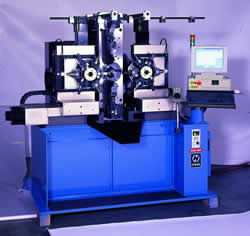 The new RX Spring Forming Centre incorporates 3D-controlled servo slides, rotary tool tables, 15 servo motors, Windows NT-based user interface, and other advanced features that make it simple to set up to produce complex springs and wire forms
 |
Advances in wire forming hardware technology
Many advances in wire forming hardware technology have been incorporated into the latest computer-controlled spring making machines. These features not only allow the production of complex springs and wire forms with amazing speed and precision, but also make the machine remarkably easy to program and operate. Thus spring making reaches a higher level of precision quality. At the same time, personnel costs can be reduced because the newer machines do not require the operating skills of an expert. Among these valuable new features are:
- Servo motors used to control wire feed with greater accuracy;
- Independent servo motors used to power each servo slide for improved wire forming flexibility;
- Servo motors powering servo spinners to bend or wind wire at high speeds;
- Rotary wire guide taking up less space, for greater forming flexibility;
- 3D traversing tool slides and rotary tool tables for improved forming flexibility;
- Servo swing system for adjustment of initial tension and servo spinner offset.
| Choosing a spring former
Spring forming machines are selected on the basis of the application and specific user needs. Is forming capability - that is, the ability to make a wide range of springs or wire forms - more important to the spring maker than set-up time? Or, is the need for a machine that sets up quickly at the expense of forming flexibility? Is production speed the main factor? How about price? The table below shows the type of performance offered by various Itaya spring machines in terms of the balance they offer between forming capability, set-up time, and speed.
Full in-house capability
Use of the best NC machine tools is one key to producing state-of-the-art spring making machines. Another is being able to access a staff of highly motivated engineers and assembly technicians who have become proficient in their jobs through long association with one industry and one company. Itaya R&D has resulted in the development of more than 200 different kinds of machines since 1947. The company has shipped more than 8,000 machines to customers around the world. |
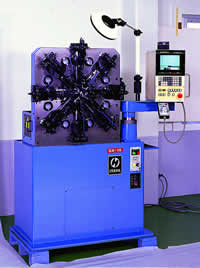
SX Spring Forming |
The innovative functions of Itaya spring formers are covered by more than 50 Japanese, German, and American patents. Itaya also takes pride in its ability to directly control all aspects of spring machine development and manufacture: from design, assembly, and marketing to after-service and technical support. The company is also one of comparatively few that develops their own electronic control systems in-house. This total capability allows Itaya to give its customers a level of service not readily available elsewhere.
As to the future direction of the industry, in 1970 Itaya instituted an electronics research department to explore the possibilities of applying computer technology to the spring making process. Differing from fastener manufacture, in which the product is created to predetermined standards, spring making demands a great deal of flexibility. |
MX Spring Forming
|
The spring must be designed and produced very promptly after development of other components. Computer technology offers the flexible control capability that can significantly shorten the time needed to design and fabricate a spring for a specific application.
Itaya's initial foray into electronic control was the MCS-15 spring former of 1977, the first spring former to incorporate a computer control system to run a pulse feed motor, and featuring forming slides radially positioned around the quill. Itaya has since developed more than 50 different computer controlled machines and measuring devices.
| Machine Type |
Forming Capability |
Set-up Time |
Running Speed |
| SX |
simple springs |
Slow |
High |
| MX, MCX, MCX |
complex springs |
Medium |
Medium |
| RX |
very complex springs |
Fast |
Low |
| CX |
simple compression springs |
Slow |
Medium |
| PC |
complex compression springs |
Medium |
Medium |
| PCX |
very complex compression springs |
Fast |
High |
Performance offered by various Itaya spring machines
Full in-house capability
Use of the best NC machine tools is one key to producing state-of-the-art spring making machines. Another is being able to access a staff of highly motivated engineers and assembly technicians who have become proficient in their jobs through long association with one industry and one company. Itaya R&D has resulted in the development of more than 200 different kinds of machines since 1947. The company has shipped more than 8,000 machines to customers around the world. The innovative functions of Itaya spring formers are covered by more than 50 Japanese, German, and American patents. Itaya also takes pride in its ability to directly control all aspects of spring machine development and manufacture: from design, assembly, and marketing to after-service and technical support. The company is also one of comparatively few that develops their own electronic control systems in-house. This total capability allows Itaya to give its customers a level of service not readily available elsewhere.
As to the future direction of the industry, in 1970 Itaya instituted an electronics research department to explore the possibilities of applying computer technology to the spring making process. Differing from fastener manufacture, in which the product is created to predetermined standards, spring making demands a great deal of flexibility. The spring must be designed and produced very promptly after development of other components. Computer technology offers the flexible control capability that can significantly shorten the time needed to design and fabricate a spring for a specific application.
Itaya's initial foray into electronic control was the MCS-15 spring former of 1977, the first spring former to incorporate a computer control system to run a pulse feed motor, and featuring forming slides radially positioned around the quill. Itaya has since developed more than 50 different computer controlled machines and measuring devices.
Toward an easier-to-operate spring making machine
Itaya Engineering is working to integrate the latest in mechanical and communications technologies to provide the spring maker with spring and wire forming machines that are easier to operate as well as more efficient, flexible, and economical to run. Whereas it once took a skilled technician hours to set up a digital spring machine, advances in the machine-user interface allow people with minimal technical training to set up the spring machine in just a few minutes. Working through the new European arm of the company, Itaya Europe GmbH in Fürth, Germany, and Itaya Europe Limited, in the West Midlands of England, Itaya expects soon be in a position to offer its advanced spring machines and engineering capabilities to a wide clientele of European spring manufacturers.
Itaya Europe GmbH
Benno-Strauß-Straße 5
D-90763 Fürth - Germany
Fax: Int'l +49 911 76 66 091
E-mail: [email protected]
Itaya Europe Limited
The Mill Industrial Park Unit 1
Kings Coughton
Alcester, Warwickshire B49 5QG - UK
Fax: Int'l +44 1789 400 886
E-mail: [email protected] |