Introduction
Until recently, wire rod coil manufacturers have been in
a Catch-22 situation when it came to attaching identification
to the coils of wire they produced. Plastic and paper tags
had the potential to make the inventory process easier with
their ability to hold bar-coded information, virtually eliminating
human error as a factor. These tags were able to survive
the process of pickling - immersion in heated baths of hydrochloric
or sulphuric acid for periods of up to 90 minutes at a time.
However, when it came to the process of annealing - baking
the wire at temperatures of 1,400°F or greater for extended
periods of time - these tags would vanish in a puff of smoke.
Applying tags after the annealing process meant a wait of
several days until the coils cooled to a more tag-friendly
temperature. This opened the door to more potential for human
error.
Metal tags breezed through the annealing process, but in
some cases would not survive pickling. Bar-coding systems
for metal tags were not suitable for all industrial applications.
This meant the use of manual inventory control, which again
meant the risk of human error. Further, the machines to stamp
the dog tags were noisy and the upkeep was high.
The first touch-free, laser-markable tag system
This was the state of the industry in 1998, when Ontario’s
Ivaco Rolling Mill, one of the world’s largest producers
of wire, approached InfoSight Corporation, USA. “At
the time, we needed more than the existing tag technology
offered,” said Mr Yves Levac, Ivaco’s Operations
Supervisor. “We had an old embossing machine we used
to manually punch out metal tags for the rolls. We would
put what information we could on them and produce the tags
by order. It was time consuming and expensive, and if there
was a change in the schedule, the new tags were useless.
With laser scanning technology everywhere you looked, we
knew there had to be a way to develop a better system.”
Qualitag® on-site metal tag printer
As a designer of custom identification solutions for the
metals industry, InfoSight created the first touch-free,
laser-markable tag system in 1995. Now Ivaco wanted to use
that technology for an automated inventory system. But according
to Mr Levac, of primary importance was the tag’s ability
to carry lots of information. “After they’re
produced, the coils go into inventory in the yard. We wanted
to use wireless scanning technology to check those coils
for quality assurance approval, and to make sure they went
to the right customer. Bar-coding would give us that and
other information, like which client the batch was for, the
diameter of the wire and the heat number. Scanning would
put all of that information at our fingertips.” In
addition, the tag needed the ability to survive the harsh
processes of pickling and annealing - not just by the manufacturer,
but by the customers as well. As Ivaco described it, the
ideal tag would be attached to the wire bundle once and would
not have to be removed for any part of the downstream process.
Such a tag would give Ivaco cradle-to-grave tracking with
superior inventory control to insure clients of a quality
product. Ivaco needed a system that could deliver one tag
every 11 seconds. “Because of the nature of the business,
it was important to have tags delivered to us in real-time,” Mr
Levac commented.
TS Tech seat frame parts
A two-hour resistance tag to acid baths
Soon after InfoSight began work on the project, complications
developed. Tests of tag formulations showed it could withstand
the pickling and annealing process, only to fail when reprocessed
by Ivaco’s customers. It turned out that each of Ivaco’s
customers had their own set of specifications in regard to
processing times, acid concentrations and baking times. This
required feedback from each client. “It took three
to six months of research and development and working with
InfoSight to get the tags right,” Mr Levac explained. “They
would make test tags for us. We would run them through our
process, then send them to our clients and have them send
them through their processes. Then we would gather up the
test results and meet with InfoSight to discuss what worked,
what hadn’t and why.”
Pic-Anneal laser-marked tags measure 3” by 6”
At the end of this time, InfoSight developed a tag that
met Ivaco’s needs - and would withstand the rigors
put upon it by the processes of their different customers.
Their Pic-Anneal® tag has a two-hour resistance to acid
baths of 20 per cent H2SO4 at 180°F and 24 per cent HCl
at 100°F. It also withstands 1,400°F heat for 48
hours and 1,800°F for 2 hours. The Pic-Anneal® laser-marked
tags measure 3” by 6” and sport a hole punched
near the top for easy attaching to wire coils. The tags are
marked with a standard CO2 laser, resulting in black print
across the light gray surface. The bar codes printed on the
tags are readable by any standard bar code reader.
Providing excellent customer service by discussing their
work
Another example of InfoSight’s reputation for providing
excellent customer service is their collaboration with the
American company Chartel Steel that produces hot rolled steel
in rod and bar form, as well as annealed rod bar and wire.
By the end of the 1990’s, they realizsed that modern
technology had to offer a better way to provide cradle-to-grave
identification of their products than what was currently
available. The initial challenge was to find something that
could withstand both the extreme temperatures of the annealing
process and the harsh acid baths of pickling. Unfortunately,
there was nothing that would, and Charter had to stick with
the industry standard “dog tags,” a piece of
metal embossed with a minimal amount of information. “The
dog tags just were not suitable,” explained Mr Tim
Leahy, Charter’s Senior Project Metallurgist. “Seventy
per cent of our coils are shipped across the street to our
own processing division. Getting the information from one
place to the other was a major issue. We needed to convey
things like the size and grade of the product, the customer
it was for and their purchase order number, the size of the
material, the grade of steel, the heat number, and our own
identification number. When you consider our production capacity,
the ability to scan becomes critical.”
Examples of Infosight's metal tagging system
Indeed, Charter produces upwards of 300 coils during the
course of an eight-hour shift. In order to properly track
the coils, they needed their tags produced in real time,
requiring two embossing machines in order to keep up with
the output. “The whole system of using dog tags was
a nightmare,” Mr Leahy said. “The machines that
made them were awful. We called them ‘thumpers’ because
they were these unwieldy monsters that vibrated themselves
to death after a period of time. We had to buy three of them
in order to have two running at any given time, and we were
considering buying a fourth.” Mr Leahy also reported
that the lack of a computer interface between the mill’s
inventory control software and the thumpers created a human
error problem. “The bumpy bar codes were unsuitable
for what we were doing. We basically put information on a
screen in front of an operator and had them type it into
the thumper, hoping to keep mistakes to a minimum. The frustration
was enormous.”
Charter knew the solution to their problem was a bar-code
system, but finding a tag that would carry the laser-readable
black marks through pickling and annealing was another matter.
The company went through a number of tags that either tore
off because of their light weight, or became smudged or banged
up when the coils were moved. “We did have one tag
that performed well, but on 15 to 20 percent of them the
readers could not scan the bar code. It was better than what
we had before, but it still wasn’t good enough”,
Mr Leahy said. At that point Charter came to InfoSight. “We
called them up and told them about our frustrations with
the thumpers and the other tags we’d tried. When they
heard that, they laughed. They guaranteed that their system
would work”. InfoSight sent Charter some sample formulations
of tags to test and discovered that some survived the process
even through they were not meant to. “These tags had
a survival rate of 98, 99 per cent, and we said we could
live with that. It was a real eureka moment” Mr Leahy
said. InfoSight jumped on this information in order to tweak
the formulation so it would best suit Charter’s needs.
Once the new formulas were tested, Charter was ready to
go online with the new system. Unfortunately, a new set of
problems surfaced that complicated matters. Research found
that the annealing process changes the chemical characteristics
in the tag’s coating that left it susceptible to damage
during the repeat of the pickling. This led to a 3 to 5 per
cent failure rate, more than twice the original. InfoSight
reformulated the tags, working on new formulations. A secondary
issue Charter had with the InfoSight product was what their
customers would think of the tags. Thirty per cent of Charter’s
product goes to outside clients, and there is no control
over how it is processed. Mr Leahy admits there was some
trepidation over what would happen to the tags, and even
set up a separate tagging system for outbound product. However,
since the beginning of 2002, they have received no complaints
on the Pic-Anneal tags.
Other challenges
In addition to this project, InfoSight tackled a number
of other challenges, including the development of a tag that
could survive the impact of a fork truck. Such challenges
are what they thrive on as the nation’s premiere creator
of fully developed custom identification solutions, including
tags, printers and the machines to apply the tags. As Mr
Ed O’Neal, InfoSight’s Laser Product Manager,
says, “If someone has a tagging need that can be solved
with a slip of paper, turn them away. We want the tough stuff… the
kind of jobs that make other companies cringe… the
kinds of jobs that other companies cannot do. This is what
we have built our business and our reputation on”.
About InfoSight Corp.
Infosight Corporation provides the industry with thermal
transfer metal tags, via its Qualitag® on-site metal
tag printer. Qualitag® produces high contrast, 200dpi
metal tags at low cost. The new innovative two-step thermal
technology is fast, quiet and requires low maintenance. The
tags bear high quality bar codes, man readable characters,
logos and other variable messages. These durable metal tags
are chemical resistant and can survive outdoor elements for
extended periods of time. They can withstand oven temperatures
of 550°F. Tag configurations include 3 and 4 inch widths,
1 to 12 inch lengths, with holes, slots, and break off sections.
QUALITAG material is available in steel and aluminium.
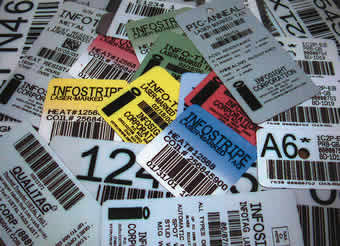
Infotag® line of metal tags
In addition, the company manufactures a high reliability,
on-site laser bar code printer for its Infotag® line
of metal tags. High-temperature tags produced from 430 series
stainless steel survive contact temperatures of up to 1,800°F
(1,000°C). Other base metals are available for lower
temperature applications. Specially formulated coatings are
highly resistant to acids and other harsh chemicals. Tag
configurations include 3 and 4 inch widths, 3/8 to 24 inch
lengths with holes, slots, break-off and fold-over sections.
|



