Introduction
Through a combination of know-how in qualified metallurgy, spring wire production and spring technology, Haldex-Garphyttan, Sweden, succeeded to develop considerable performance improvements of the well-known steel grade AISI 631/Werkstoff 1.4568. The steel grade Garba 177 supreme is a stainless steel for the highest fatigue requirements, comparable to those that valve springs are exposed to.
|
According to recent estimates, world consumption of stainless steels increases by approximately 5% per annum. This is also true for stainless spring wire. At the same time, the demands for higher spring loads increase. The choice of the best performing material for different applications is, therefore, becoming more and more important. The Swedish company has a long lasting history as a world leader in the production of valve spring wire. Parallel to this product, Garphyttan has used existing know-how to emphasize the production of stainless spring wire in the segment where the highest fatigue resistance is required. Particularly, the precipitation hardening steel AISI 631/Werkstoff 1.4568 has been in focus. The company designation for this steel is Garba 177 PH, where PH stands for "Precipitation Hardening". |
Spring wires for combustion engines (valve springs, priston rings, compression rings, fuel injection springs)
|
Spring properties with stainless spring wire
Stainless spring wire of the type AISI 302/Werkstoff 1.4310 attain spring properties, such as tensile strength and relaxation properties, through cold deformation of the austenitic grain structure in the matrix. A typical structure can be seen in Figure 1. In Garba 177, on the other hand, the chemical composition has been optimized also to transform some of the cold deformed austenite into martensite, provoking an increased strength of the material.
One could say that the austenitic structure gets ‘reinforced’ with martensite, the result is thus a duplex structure austenite-martensite (Figure 2a). Despite this transformation, the wire maintains its good coilability properties and springs can be formed as normal. After coiling, the tensile strength is increased considerably by the precipitation hardening. The higher hardness is achieved through microscopic Al-Ni-precipitations in the steel matrix.
The corrosion resistance is only marginally influenced. All properties of interest for spring production are positively influenced: high fatigue strength, low relaxation also at elevated temperatures, coilability and dimension stability at the precipitation hardening. In the table, comparisons of tensile strengths can be made.
Increased importance of high fatigue strength
Especially in the automotive industry, the requirements are steadily increasing concerning fatigue properties. Garphyttan wire has a special laboratory with 56 machines only for fatigue tests of oil tempered valve spring wire. With this equipment process and product development, in co-operation with qualified steel producers, is carried out. The Oteva valve spring wire has been developed in such a co-operation. The basis for all qualified spring production is formed already in the metallurgical process of the steel mill. Fatigue failures of springs have two primary causes: the steel cleanliness and the surface condition of the wire (resp. the spring).
Garphyttan introduced an improved surface standard many years ago. It is a surface shaving process, where inevitable small defects from the hot rolling of the wire rod surface are eliminated. |
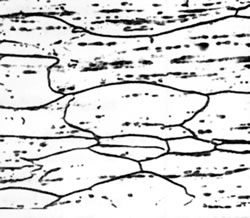
Figure 1: Cold formed austenitic structure
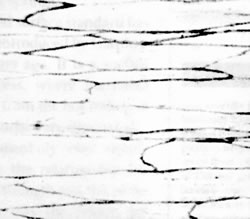
Figure 2a: Martensite and austenite
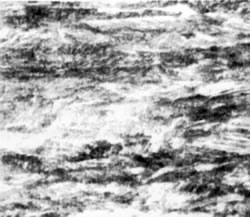
Figure 2b: Austenite, tempered martensite and Ni-Al- precipitations
|
|
Grade
|
Standard
|
Tensile Strength
(N/mm2)
1.0-1.5mm / 2.0-2.8mm
|
Execution
|
Garba 177PH |
AISI 631 |
1700-1950
|
1500-1750 |
2000-2400 |
1790-2200 |
|
Cold drawn
Precipitation hardened
(480°C, 1 hour)
|
Garba 188 |
AISI 302 |
|
Cold drawn |
Table: Property comparisons (indicative values)
| The fundamentally very simple theory about the relationship between fatigue strength and size of defects (Figure 3) was the reason for Garphyttan to intensify a further development of the metallurgical properties together with the steel research departments of the wire rod suppliers. |
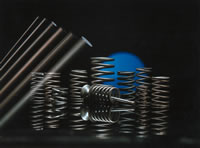
Garphyttan oil tempered spring wires
|
Figure 3: Influence on fatigue properties from internal defects
Special steel melting process
In the last ten years, there has been a rapid change of processes in the stainless steel industry. Continuous casting has replaced ingot casting. As far as low alloyed spring wire steel grades are concerned, e.g. valve spring wire of Si-Cr-alloyed types like Oteva 70, a very high steel cleanliness can be achieved with conventional continuous casting after the so-called super-clean melting process. As far as high alloyed steels are concerned, e.g. tool steels and stainless steels, additional process steps are necessary.
By introducing Electro Slag Refining (ESR), originally introduced for the most qualified tool steels, a considerable qualitative improvement was achieved. Primarily, freedom from harmful inclusions and a lower segregation level at steel solidification are of importance.
The continuous cast billets from the steel mill, after processing with ladle injection, serve as electrodes in the ESR-furnace. The electrode dips with its’ lower end into a fluid slag bath having a chemical composition adapted to the steel grade in question. A current (AC) passes through the electrode, slag bath and mould, and the necessary heat (resistance heat) for melting of the steel electrode is evolved in the bath. As the molten steel falls in drops down through the slag bath, the intended metallurgical reactions, refining, take place (Figure 4).
Figure 4: The principle of ESR (Electro Slag Refining)
The solidification of the new ESR-ingot from below is homogenous over the cross section. In Figure 5 the effect on inclusion levels and segregations of alloys on a 5% Cr tool steel (type H130) is illustrated.The ESR-process must be carefully adapted to each specific steel grade to reach the optimal properties. This is especially true for a complicated steel composition (high Al-content) like AISI 631/Werkstoff 1.4568. In developing the ESR-refining technique, Garphyttan co-operates with the Swedish quality steel producer Uddelholm Tooling (the Böhler-Uddelholm group). The original steel melting and wire rod production is developed together with Avesta-Sheffield and Fagersta Stainless.
Figure 5: Non-metallic inclusions and alloys segregations (Inclusions: pictures from microscope from a test area of 350mm2 projected on each other; segregations; measured with electron microscope)
Optimizing properties
The described processes, in combination with further special treatments in the wire drawing, of which essential parts are patented, are the bases for the new, optimized Garba 177 Supreme. The final test of the improved properties, however, will only be the actual use of springs produced from the new material. Large and reputable companies (Robert Bosch GmbH among others) have performed a series of fatigue tests over 50 million cycles with excellent results. The properties of the material close to the wire surface are out of utmost importance for the fatigue resistance. The cleanliness of oil-tempered valve spring wire is regularly tested in a rotating load test (so-called Nakamura test, Figure 6).
Figure 6: Nakamura-test (principle)
In the laboratory, the know-how of this method was used to further develop detection of harmful slag inclusions in steels of type AISI 631. Usually, inclusions are counted and measured in an optical microscope, where only a very limited area can be inspected. With the Nakamura-test, a tubular part of the wire is exposed to critical loads and examined to 100 per cent. Presence of harmful inclusions will lead to unavoidable fracture of the test piece. This gives a much higher safety margin when judging the cleanliness of the steel than ordinary methods. For AISI 613, an almost linear correlation between the number of cycles to breakage and the inclusion size has been found (Figure 7).
Figure 7: Results from Nakamura testing
In Figure 8, the fatigue resistance for different executions of wire in Garba 177 can be seen. Goodman-diagrams for highly stressed springs made from conventional AISI 631 and Garba 177 Supreme are compared. The superiority of Garba 177 Supreme is evident.
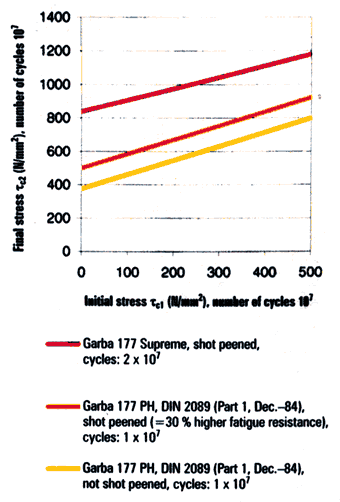 Figure 8: Comparison of fatigue resistance Figure 8: Comparison of fatigue resistance
|