Introduction
Whether installed new or incorporated into an existing line,
the triple-twist® process from Gauder Group, of Belgium,
allows up to 50% higher production speeds than conventional
LAN pairing lines, while yielding the same cable quality.
To enable cable producers to maximise the triple-twist process,
Gauder has introduced a new series of equipment offering
all the benefits of backtwist technology, combined with those
of the company’s popular DVD 560. More than 400 of
these units have been sold.
Among the advantages of the new Model VTT 560 for Cat. 5,
6, and 7 LAN cable manufacturers are: stabilised impedance,
superior consistency, and hydraulic loading platform and
pneumatic pintles for easy reel handling, as well as an integrated
electrical cabinet and auxiliary stand-alone equipment. The
backtwist rate is continuously adjustable by way of the operator’s
control panel.
This article highlights the basic principles of triple-twist
technology from Gauder, a group already well known as specialists
in the design and manufacture of double-twist units.
Increased productivity from lower investment
Gauder’s Model VTT 560 vertical triple-twist LAN pairing
unit offers integrated backtwist (essentially, no-twist)
pay-offs. An all-in-one design, the VTT 560 handles speeds
up to 6,000 twists per minute. The pay-off may be utilised
as a twinner, joining two insulated wires by means of the
bow cabler principle (Figures 1 and 2).
Figure 1: Gauder Group VTT 560 vertical triple-twist machine
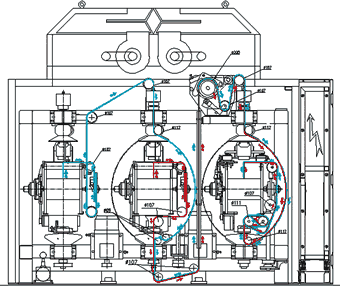
Figure 2: The new VTT 560 wire path
Principle of the triple-twist process
The VTT 560 vertical triple-twist machine acts earlier in
the process than a standard double-twist pairing machine,
whereby two twists are added on the pair in order to produce
three twists per bow revolution. Instead, the VTT 560 generates
a first twist on the pair of wires without having imparted
any twist to the single wires themselves.
The difference is apparent in the output. For Cat. 5e pairs,
some 6,300 twists per minute are produced with the VTT 560,
as compared with 4,500 twists with a standard 560mm double-twist
twinner. Category 6 pairs can be produced at speeds of up
to 6,000 twists per minute (versus 4,000 twists on a standard
560mm double-twist twinner) (Table I).
| Pairing speeds |
With Triple-TwistVertical Triple
Twist MachineVTT 560
Or Pairing Line with DoublePosition Pay-off
DVD TT 560 R + TA 560 Ni |
Without Triple-TwistPairing Line
with DoubleBacktwist Pay-off
DVD 560-2-3M + TA 560 Ni |
Ex. for Cat. 5E pairs |
6,300 twists/min |
4,500 twists/min |
Ex. for Cat. 6 pairs |
6,000 twists/min |
4,000 twists/min |
Table I
Given these higher (up to 50%) speeds, fewer machines furnish
the equivalent production capacity. Accordingly, users of
the VTT 560 vertical triple-twist unit can expect to see
cost and time savings in total investment, floor space requirements,
installation, maintenance, power consumption, commissioning,
shipment cost, etc.
Double-position payoff
Similar results can be expected from the double-position
payoff from the Setic-Gauder Group. Type DVDTT 560 R also
activates its triple twist earlier in the production process
than current models of the standard double-twist machine.
This machine raises running speeds from 1,500 up to 2,200
twists per minute in the production of Cat. 5 through Cat.
7 cables. The twinner can also be used for other products
(Figures 3 and 4).
Figure 3: Setic-Gauder Group double-position payoff Model
DVDTT 560 R (left) with model TA 560 Ni (right)
Figure 4: Schematic drawing of the Model DVD TT 560 R
with model TA 560 Ni
The Model DVDTT 560 R also permits the use of an existing
standard double-twist twinner for high-speed (6,000 twists
per minute) Cat. 5/6/7 pairing. By increasing total production
capacity without the purchase of an additional twinner, the
unit substantially reduces investment costs.
Cable quality improvement
The increase in productivity with the use of the model DVDTT
560 R does not impose any sacrifice in quality. As Figures
5a and 5b demonstrate, the NEXT (near end crosstalk loss)
level remains very low with the DVDTT 560 R. Impedance stability
is also very good (Figure 6). These results mainly are generated
by:
- Backtwist (no-twist) effect on the two single wires.
The pay-off unit works as a bow cabler to twin the two
wires. The pair is produced at pay-off output without any
twist
on each wire;
- Payoff tension control. Wire tensions are
equal at the twinning point. Using two load-cells, the
machine controls
two different paying-off tensions so as to equalise
tension of the wires at the twinning point;
- Optimised wire
path (reduced bow balloon) and dancer-regulated take-up
tension;
- High-accuracy lay length, controlled by a motorised
capstan driven by a brushless motor;
- Use of a middle
capstan at payoff output to reduce the tension of the
pair before entrance into the
double-twist take-up unit.
Figure 5a: UTP Cat.6 production: NEXT level remains very
low
Figure 5b: UTP Cat.6 production: Good impedance stability
Figure 6: Backtwist (no-twist) effect
Cable quality with the Model DVDTT 560 R is similar to that
obtainable from a double-twist twinner operating in combination
with a backtwist pay-off. Pairing high-quality Cat. 6 cable
at 6,000 twists per minute is a production reality. Thousands
of kilometres of cable have been manufactured on this type
of machine, and the quality and consistency of the product
are appreciated by the leading LAN cable producers who have
availed themselves of this process for over two years.
Floor space reduction
To return to the VTT 560, no effort has been spared to render
it - together with the well-known TA DVD 560 version - a
hallmark of compact and user-friendly machinery. Among its
features:
- Two pay-offs and a pairing unit placed side-by-side
in a safe and soundproofed enclosure on the same frame.
All operations and servicing are readily performed from
the front;
- Vertical shape for the three cradles;
- A built-in electrical
panel on sliding guides so that machines can be installed
back-to-back and side-by-side.
Operations
can be carried out directly with a clear view of
effects on the machine that is running.
Figure 7: Space saving with VTT 560
Given the very compact design of the VTT 560 (and the fewer
units required, as a result of higher pairing speeds), floor
space requirements are reduced by up to one-third. As demonstrated
by Figure 8, an area of some 203m2 is necessary for ten double-twist
twinners with integrated payoff. In contrast, an area of
only 66m2 suffices for placement of seven VTT 560 units offering
the same production capacity.
The DVDTT 560 R variation also includes vertical cradle
and bow, and an electrical cabinet located on the sliding
frame. This permits either back-to-back or side-by-side positioning.
Other features of triple-twist machines from Gauder Group
include:
- Easy maintenance thanks to AC bow motors and take-up
reel and capstan brushless motors. The maintenance programme
is
displayed on the operating panel;
- User-friendliness, as
all production parameters can be adjusted from the touch-screen
colour panel: lay length,
no-twist (backtwist) rate, pay-off tension, takeup
tension, speed, production length;
- Easy, safe, and quick
handling of the reels, with the use of hydraulic loading
platforms and pneumatic
pintles;
- Quick installation (less than two hours for
the VTT 560)
- Handling of the machine in one part (including
soundproof cabinet and electrical cabinet)
- Plug
and play design.
Figure 8: Gauder Group VTT 560 vertical triple-twist machine
needs less space than a conventional unit
Conclusion
For more than two years now, triple-twist twinners from
Gauder have been producing LAN pairs in major cable manufacturing
plants. With the 60-plus triple-twist twinning lines sold
by Gauder all giving satisfaction, their productivity and
cable quality benefits are defining the triple-twist as the
new industry standard for LAN cable pairing. Other types
of machinery are designed and produced by the Setic-Gauder
Group, of France, where demonstrations and trials may be
arranged. This affords the prospective buyer an excellent
opportunity to examine the wide array of Setic-Gauder machinery
currently available for LAN production, and to preview units,
now in the design stage, that are about to go into development.
Gauder Group
Rue de la Révision 93
B-4032 Chênée (Liège) - Belgium
Fax: Int’l +32 4 367 87 98
E-mail: [email protected]
Website: www.gauder.be
|



