Introduction
In recent years the Gauder Group, a worldwide specialist in metallic and fibre optic cable-making equipment, has invested massively in the development of pioneering machinery - principally payoffs and take-ups, but also winding and rewinding lines for very specific purposes.
The combined expertise of all Gauder Group units (SETIC, MAPRÉ, Fiber Optic Div.) has contributed to the development of a wide range of equipment adapted to the handling demands of bare copper, insulated wires (telephone, LAN, special cables), very fragile cables, and special products (fibre optic, thin-coated, aramide, tapes), as well as many others.
A complete range of equipment
The entire Gauder range of pay-off, take-up, and winding systems has been designed to meet the following criteria:
- Centring on a perfectly straight fibre and cable path to ensure that the product retains its intrinsic qualities, and to improve cable quality under the application of backtwist;
- Operator-friendly loading and threading;
- Affordable investment costs and manufacturing economies;
- Excellent tension control, with minimum tension levels maintained by low-friction pneumatic dancers, load cells, AC motors, brushless servo-motors, vector drives, etc.;
- Compact shape and size for space savings of up to 70% in the production area. Modular units such as built-ins and sliding integrated electrical cabinets facilitate shifting of machinery;
- Customer specifications followed to the letter. Custom-designed models available to suit unusual needs and requirements;
- Utilisation of the experience of able partners in this field.
Pay-off units
Gauder offers pay-offs in different versions according to application, reel diameter, and product sensitivity.
1. Fly-off type pay-offs
These are simple devices, initially and traditionally used for bare multi-end copper cores in bunching or stranding applications. Most of the time, tension is achieved by means of mechanical or hysteresis brake (model DVP800S). But increasingly these units are driven by AC motors for more perfect adjustment of the tension (up to several kilos in special applications) to the desired draw-down during process. They are also available in an upgraded version for fragile products that must be paid off without twisting. This solution will be more fully discussed below (“backtwist pay-offs”).
2. Roll-off type pay-offs
This is probably the payoff in widest use in the cable industry. It is available in a number of versions, among them cantilever, portal, self-traversing, gantry, and column type. As with the fly-off payoff, the tension here can be achieved by mechanical or electric brakes. But, more often, tension is controlled with dancers, motors, and drives. While weight-loaded dancers furnish the most effective method of regulation, pneumatic dancers allow for very easy tension tuning and constant control, even from a remote station. They must be heavy-duty for copper products; strong and with big deviation pulleys and good tension control for insulated products (such as LAN single wires, pairs or quads); and offer very fine tension regulation for fibre optic products.
In addition to its standard range, Setic-Gauder offers such dedicated products as its Model DBM630, an easy-use pintle-type payoff designed to be very cost-effective for users of 630 DIN reels. This is by no means a “simplified” pay-off. It ensures reliable tension regulation by means of a pneumatically loaded dancer, AC motor, and vector drives and wire separation for Unilay production.
The cost-effective roll-off payoff, Model DBM630
The model DRM630HV with pneumatic tension control was developed for use in extrusion lines at high speeds (800 m/min).
Pay-off and take-up in high-speed rewinding line (800m/min.), models DRM630 and ERM630
The longitudinal taping head may be considered a roll-type pay-off with improved tension control for use with a wide range of thin and fragile tape material. Additional tension multipliers can also be employed to compensate the difficulties with fragile edges of certain spools (traverse packs). One taping head - the concentric type TRCB300 - combines two technologies: roll-off and fly-off. It is offered in two versions, one for spools and the other for pads. Both units have a dancer located on the centre shaft for protection from the centrifugal force effect. One motor drives the taping cage, which imparts the taping lay; a second one drives the spool itself, with positioning as to the dancer for constant taping tension up to 2,000rpm. The binding head type TGC250-1-2M (taping tension up to 3,000rpm) works on the same principle, but with a load cell instead of pre-loaded dancer.
Driven and tension-controlled concentric taping head, model TRCB300
3. Multi-position pay-offs
With two to 64 heads or even more, multi-head payoffs from the Setic-Gauder Group see service in a wide variety of applications. Among them: telephone cable (brake or torque-control payoffs); smooth Unilay strands with separated multi-end bare copper wires (two-position driven and pneumatically tension-controlled pay-offs); four-pair LAN cabling (dual-position driven and tension-controlled units); and backbone 25-pair LAN cables (individual AC-driven and dancer controlled multi-heads). Multi-head pay-offs are available in all the configurations of the individual units and promise the same product quality, floor space reduction, and cost savings. They can handle products ranging from aramide reels for rope application and enamelled wires to paper tapes for rush chair-bottoms.
4. Backtwist pay-offs
Setic-Gauder is a specialist in backtwist for pay-offs but also in the use of this technology in group twinners for high-quality LAN products (Categories 6, 7 and 8) and in planetary stranders for very specific applications. These include tight buffer cabling on 12- to 24-reel cablers, and 40-position cage stranding for supra-conductor service (up to 500% backtwist or overtwist). The units employ both single- and double-twist principles.
4.1. Single-twist backtwist pay-off
These are in use mainly with single-twist cabling machines and work on the same principle, with a flyer arm rotating around the driven and tension-controlled pay-off reel. According to the application, flyer and reel will control not only the backtwist rate, but also the tension by means of a dancer capable of rotating to augment backtwist effect during travel through the deviation pulleys. The dual vertical single backtwist pay-off type DSD630-2-3M-VT (see photos 4 and 5) is especially appreciated by coaxial cable manufacturers because it permits high-production speeds (600rpm) whilst taking perfect care of fragile foamed insulation. These units are mainly used with a single-twist cabler, either type AST1000R (900 RPM) or AST1250 (500 RPM).
Dual vertical single backtwist pay-off, Model DSD 630-2-3M VT
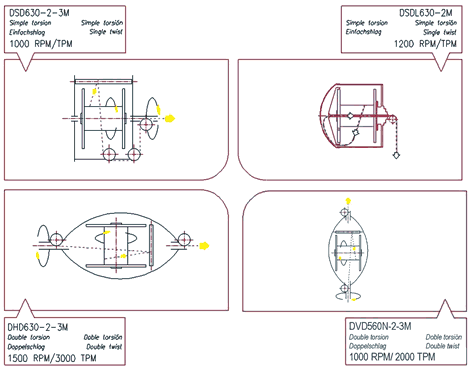
Single- and double-twist backtwist principle
Another type of single-backtwist pay-off is in fact more of a no-twist pay-off, in the sense of a rotating cradle developed for such special applications as multi-layer products requiring that the central core, even if already stranded, remains untwisted in the final product. Rotating cradles are available for reels from 630 up to 1,000mm, for bare or insulated copper strands.
4.2. Double-twist backtwist pay-off
The well known model DVD560N-2-3M is the vertical dual position backtwist pay-off used by all the major names in the copper LAN cable market. Setic-Gauder Group has placed more than 500 units all over the world. This backtwist pay-off not only pays off single insulated wires (solid or FFS PE, FEP…) with perfectly controlled tension (driven and dancer-controlled reel), but also improves product quality thanks to the backtwist effect. This pay-off helps ensure constant quality and scrap reduction by nullifying small defects in single wires (centring, adhesion, etc.).
It is worth restating the principle that single wires are twisted in the direction opposite to twinned wires. This prepares the pre-shaped single wire to come smoothly into the pair, thus reducing the constraints between the two conductors. The insulation is protected, and the copper core remains at a constant distance. In addition, the copper has a certain “memory” Its being twisted and untwisted induces a random effect to compensate the copper offset in the insulation. Fuller information on impedance stability and backtwist improvement effects is available. Backtwist pay-offs are now integrated in a double-twist twinner (Model TADVD560) for savings in floor space, ease of use, and economy.
Integrated backtwist pay-off, model TADVD560
Take-up units
Mechanically, Gauder Group take-ups are built on the same principle as the pay-off units, but include as well everything required for perfect winding. The range includes efficient traversing devices and, for very top quality, a straight cable path, self-traversing take-up.
1. Independent single or dual take-up
Setic-Gauder Group offers a standard independent take-up for incorporation into existing lines (extrusion, taping, rewinding) for reel diameters ranging from 250 to 1,000mm. The Mapré-Gauder Group range covers the bigger capacities (up to 3,400mm). Dancers can be placed in front of the take-up for precision control of constant and smooth-winding tension. Product geometry is protected from damage by excess pulling. The traverse pitch is generally obtained through a driven screw, allowing in-line and stepless pitch setting from recipes. Dual take-ups, type FO-ERMP630, are also available. Each position can be accessed independent of the other. This configuration allows for a very large reduction in floor space.
2. Automatic or semi-automatic dual take-ups
Full automatic double spoolers have been developed for use in Mapré-Gauder insulation lines, as well as to upgrade existing lines. Model EDA630, designed for 200kg DIN 630 reels, runs at 2,400m/min with automatic change-over. It is equipped with an integrated electrical cabinet, allowing easy integration into existing lines. Semi-automatic dual take-ups have also been developed for very fragile products and fibre optic application. Model FO-EDA1000LT can handle DIN1000mm reels. Model FO-EDA500TB can handle a range of 300 to 500mm Ø reels with very low and controlled winding tension (to 150gr) by means of a low-friction pneumatic dancer (to 800m/min.) These units are used for very thin and fragile insulated copper wires and are specifically adapted to tight buffer or loose-tube products. For fragile material, Model FO-EDA500 is a self-traversing dual take-up allowing the product to remain straight and in-line throughout, thus preventing excess bending damage.
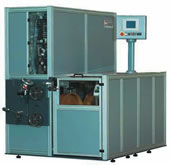
Semi-automatic dual self-traversing take-up, model FOEDA560-TB
Rewinding / respooling lines
Since the rewinding operation does not in principle generate added value, this operation must maintain optimum speed quality. This stand-alone machinery is developed to be independent, compact with a very reduced footprint, and readily movable.
1. Flexible and evolutionary lines
Those lines feature independent pay-off and take-up, allowing intermittent placement of various testing devices (lump and neck-down detectors, diameter controllers, spark testers, etc. As distance between pay-off and take-up is adjustable, the lines can also be used for printing information on the cable.
Setic-Gauder has supplied many different lines for 630 (DRM630-ERM630 - see photo 2) or 1,000mm DIN reels (DRM1000-ERM1000) for bare copper insulated wires, as well as for fibre optic cables (FO-DEM1000) or supra-conductors. Most of the time those lines are designed according to customer specification and are flexible enough for use with a very wide range of payoff or take-up reels in different applications (testing, re-spooling for packaging, printing, etc.). Some lines are also fully bi-directional: the pay-off and take-up are matching units, equipped with a traversing unit as well as a pneumatic dancer. They can be used independently in both directions. Generally speaking, in such lines a PLC takes care of line control and also allows work with recipes.
2. Compact and stand-alone lines
The company’s most compact (and most famous) rewinding line, the ICL630/800/1000, is used by hundreds of manufacturers in a very wide range of applications. The ICL allows testing, rewinding, and printing, and is a very compact stand-alone unit with an integral electrical cabinet for easy use in different areas of the workshop.
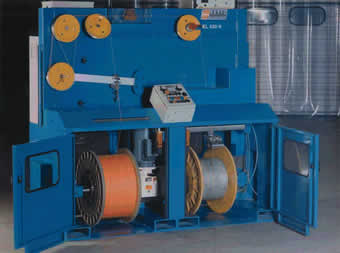
Rewinding and testing line, model ICL630N
Setic-Gauder has become a specialist in lines for bare copper, supra-conductors, special cables, coaxial cable, and fibre optic cable because its range of machines combines a very smooth cable path with large deviation pulleys for perfect tension regulation via a pre-loaded dancer. The self-traversing unit Model FO-ICL800ST optimises the product path by keeping it straight, which is particularly appreciated for such flat products as ribbon, duplex, and bonded wires.
A very optimised Setic-Gauder rewinding line for bare fibre or extra-fragile products allows for rewinding on 450mm reels at 3,000m/min with very low and controlled tension (60gr). Model FORW450 comprises a self-traversing pay-off and self-traversing take-up, installed one above the other for floor space optimisation, and both driven by brushless motors and drives. They feature automatic flange position adjustment. The operator dictates the flange dimensions of the reel from the PLC, and the machine automatically adjusts the winding whilst running to prevent build-up or valleys against the flanges. This feature, combined with pneumatic pintles and vibration-free running, is warmly appreciated by users of FORW450 rewinding lines for bare or coloured optic fibres and also for very fragile insulated wires.
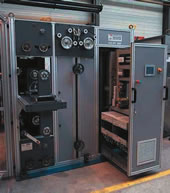
Compact high-speed low tension rewinding line for fragile products, model FOPT450
|