| Introduction
More
and more households are equipped with
electronic devices: TV, VCR, PC's, phones,
video cameras, etc. The aim of telecommunications
operators is to distribute many kinds
of services (home automation, phone, multimedia,
video, etc.) behind different types of
broadband access networks such as cable,
satellite, ISDN, xDSL, and FTTx. These
services have to be available in each
room, creating a small local area network
(mini-LAN) in the house. Different media
can be used: wired (copper pairs, optical
fibres) and wireless (radio, infrared).
For wired solutions, a major question
is the use of new cabling, with problems
of installation, cost, etc. The use of
existing low-voltage network (power line)
offers the advantage of providing service
to every room of the house.
Indoor
low-voltage network (power Line)
Power line, the medium
in PLT, is defined in relation to the
parameters of topology, cable length,
outlets, etc., and characterised under
two conditions: with and without voltage
in the line. Most significant for good-quality
transmission are attenuation and characteristic
impedance. This section describes the
measurements of characteristic impedance
and attenuation in two ways.
Figure 1: Low-voltage network diagram
(House N° 1, Room N° 1)
Evaluation of power
line infrastructure - Definition of the
infrastructure under test
The infrastructure is made up of a low-voltage
network, "House N°. 1,"
with two rooms 70 metres apart. The network
installed in House N°. 1, Room N°.
1 is shown in Figure 1. The legends indicate
line number, outlet number, and length
of the line from the repartition tab and
the outlet, in metres. This network is
typical of residential customers with
one single-phase electrical meter, one
500mA differential circuit breaker, and
a repartition tab equipped with a fuse
for each line in the room (Figure 2).
Figure 2: Installation of the indoor power
line infrastructure
These lines are made
with traditional cable (HO7 type), as
used in residential houses. One line is
made with both traditional cable (line
2) and a new twisted-pair cable with 70mm
lay (line 6) for comparison of the characteristic
performances of PLT.
Measurement devices
The measurement method used for power
line is the same as that for telecommunications
cables. All power line measurements are
carried out with a network analyser. The
analyser is connected to the network via
an adaptation box and two baluns for the
measurements under voltage. The attenuation
measurement is shown in Figure 3, that
for characteristic impedance in Figure
4. The network analyser does not allow
for high voltage, so adaptation boxes
have to be used between power line and
the device used to carry out the measurement
under voltage.
Figure 3: Attenuation measurement
Figure 4: Characteristic impedance measurement
Attenuation measurement
without voltage
Figures 5 and 6 show the attenuation curves
of the power lines in a frequency band
up to 100MHz for 50m lines with four outlets.
The line disconnected from the repartition
tab is not taken into account in the measurement.
The average attenuation is approximately
the same for the two types of cable, with
better regularity for the twisted-pair
cable.
Figure 5: Attenuation measurement of traditional
cable
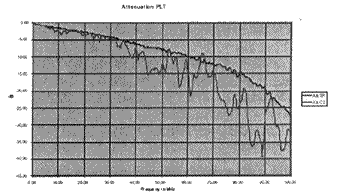
Figure 6: Comparison of attenuation for
traditional cable and twisted-pair cable
Characteristic impedance
without voltage
Figure 7 shows the characteristic impedance
curve of the power lines (classical cable
and TP cable) in a frequency band up to
100MHz for the same line (50m, four outlets).
Since the line is disconnected from the
repartition tab, it is not taken into
account in the measurement. For traditional
cable, the impedance fluctuations are
high and depend on several parameters
(cable length, number of outlets, number
of connected devices, etc.). For the twisted-pair
cable, the curve is more stable and the
average value fluctuates slightly around
50 and 100 Ohm.
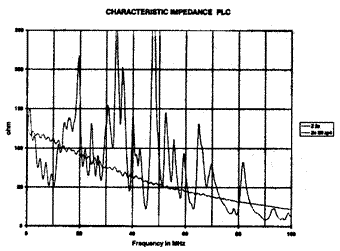
Figure 7: Comparison of characteristic
impedance for traditional cable and twisted-pair
cable
S-parameters (cables
under voltage)
The measurements taken are the impulse
responses of the transmission channel
and the S21 parameter. The equation of
the S21 parameter is as follows:
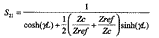
The attenuation (or
insertion loss) is calculated with the
S21 parameter as follows:
As previously stated,
these measurements are made with adaptation
boxes to de-couple the 50Hz so as not
to destroy the measuring equipment and
to be able to inject and recover the signal
on the power line. These coupling/de-coupling
elements are constructed as shown in Figure
8.
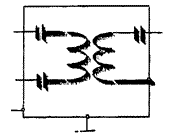
Figure 8: RF/electrical line coupler
The coupler characteristics
are: 5dB transmission loss and -10dB return
loss in a frequency band from 1 to 30MHz,
sufficient performances to simulate the
future device implemented in the final
modems. A serious limitation for the time-domain
measurement concerns the choice of the
pulse width and shape.
The selected parameters
are:
- Frequency band: 1 to 100 MHz;
- Time domain: 0 to 500ns.
The main parameters
analysed are:
- Several line lengths, up to 100m, representative
of most of the lines in a house;
- With and without interference (TV, heater,
etc.)
Figures 9 and 10 show
measurement results for the same test
line (50 metres, four outlets).
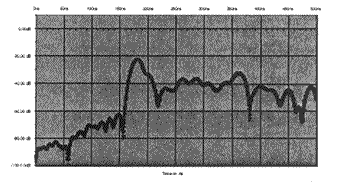
Figure 9: Impulse response
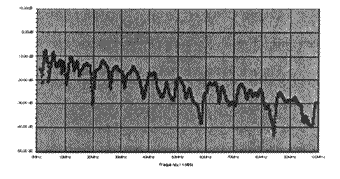
Figure 10: (s21) parameter module
To summarise, the first
results for the low-voltage network show
a small difference in parameters between
the measurements with and without voltage.
This needs to be confirmed by further
measurements. The result under voltage
is informative because it is representative
of a real environment. The next step is
to carry out these same measurements in
customers' houses during field trials.
The characteristics of the twisted-pair
cable are better than those of the traditional
cable, and the use of such a cable would
allow power line transmissions to be optimised.
Equipment
tests
PLT systems, and other
communications broadband systems such
as ADSL, must meet the same criteria:
reliable transmission of data with advanced
modulation technologies (OFDM or GMSK),
and error controls free of emission and
conduction noises that pollute the electromagnetic
environment. Following the example of
xDSL technologies, the main application
for PLT is to provide Internet access
with average and high bit rates.
Transmission tests
with IP server
The first goal is to verify that services
offered to future ADSL customers can be
transported on low-voltage networks using
PLT modems. The second goal is to analyse
the transmission quality of one or several
of these services according to simulated
services, channel quality, electrical
perturbation, and others.
Test configuration
The test configuration is as follows (Figure
11):
- Modems placed at the end of the lines
for maximum length;
- Modems and PC IP addresses chosen to
operate under a sub-network specified
in the ADSL modem/router;
- Bit rates are: (downstream) 1.20 Mbit/s
max., (upstream) 0.76 Mbit/s max.
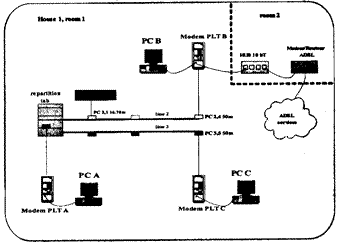
Figure 11: Test set-up with PLT modems
connected to an IP server
Quality of transmission
with IP services on power line
First, PLT modems are tested with IP services
simulated using simulation software. Second,
access to real services is verified. Third,
other services are added with the simulation
software. Then several parameters are
analysed (number of applications required,
frequencies, power).
Tests with simulated
IP services
Without interference: With file transfer
tests, the minimum power for satisfactory
running without interference is calculated.
The results show:
- Frequency: 5 to 25 MHz;
- Minimum power: -37dBm;
- IP Test: OK;
- FEC Led: no error.
The configuration used
without perturbation shows a good transmission
with minimum power (-37dBm) and a bit
rate of 1.27 Mbit/s.
With interference: The
use of a hair-drier, connected as shown
in Figure 11, produces transmission stops
and even modem de-synchronisation with
the previous minimum power (-37 dBm).
The emitted power Pe = -25 dBm is then
chosen to measure the effect of interference
on transmission.
Tests with real and
simulated IP services
The goal is to monitor the behaviour of
the PLT modems under increased demand
for service.
Without interference:
The superimposition of video services
and file transfers can be carried out
properly in these conditions:
- The number of file transfers is kept
quite low (two with voice over IP);
- These transfers must avoid the modems
used for video services.
If these conditions
are not met, the following faults occur:
- The video bit rate fluctuates and decreases;
- The image then becomes fixed;
- File transfer bit rates increase (Figure
12);
- The global bit rate stays about 1.3
Mbit/s.
Figure 12: Bit rates variation with several
service applications
There is no obvious
synchronisation between the fluctuation
of the image quality and the bit rate:
a shift of a few tenths of a second.
With interference: The
previous remarks can be repeated here.
New information (Figure 13) is as follows:
- The use of the hair-drier reduces the
bit rate, which decreases from 1.3 Mbit/s
to 1.1 Mbit/s with a power level of -25dBm;
- Again, the use of the hair-drier creates
interference at all frequencies.
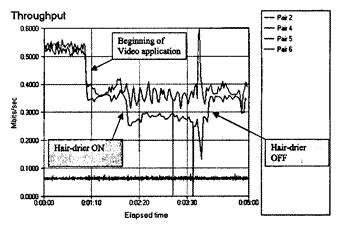
Figure 13: Bit rates variation
To summarise, the test
results are:
- The IP configuration of PLT modems is
correctly designed for adaptation at the
connection to the IP services;
- The behaviour of the services and bit
rates as to the constraints of several
service demands is normal.
EMC
Test configuration
A point-to-point link is made between
two PC's with Ethernet interface via PLT
modems and the low-voltage network. For
conduction measurements the modulation
used by the modems is GMSK, for good spectral
efficiency. For emission measurements,
the modulation used by the modems is OFDM.
Conduction measurements
Measurements of the signal and direct
noise on the low-voltage network: The
principle is to have the frequency spectrum
with and without PLT signal on the line
between 10kHz and 30MHz (Figure 14).
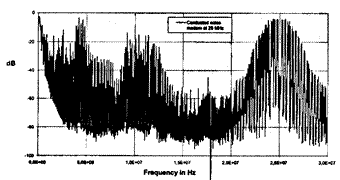
Figure 14: EMC measurements on the low-voltage
network
The noise is recorded
instantaneously. A PLT carrier is seen
at 25MHz with a level of -5dBm, and noise
can be seen up to about 15 MHz. The relatively
high noise on the low-voltage network
around 5 MHz and 10 MHz shows the small
margin available in these frequency bands
to operate the PLT. The question becomes
whether this noise is intrinsic to the
line or related to the environment.
Measurements of conducted
emissions with LISN according to the EN55022
standard: The line impedance stabilisation
network (LISN) is placed in series with
the line and allows conducted HF interference
to be measured according to the standard
EN 55022. This is a common mode measurement,
between phase-earth and neutral-earth.
With the PLT signal being emitted between
phase and neutral (differential mode),
this measurement is taken to evaluate
the way in which this test should be applied,
standard-wise, to the PLT (Figure 15).
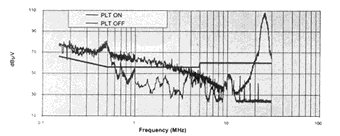
Figure 15: Measurements with LISN
The PLT carrier at its
maximum level exceeds the limit of the
standard by about 40dB. Taking into account
the measurement conditions, the results
must be relativised. The actual value
is below 40dB. The result shows that:
- Generally, PLT has more interference
than xDSL systems (in particular ADSL);
- The intrinsic noise of the low-voltage
network is a serious problem for the efficient
running of PLT because, even with modems
shut down, the limit of the standard is
exceeded at some frequencies (around 500kHz).
This initial research
on the measurements of conducted noise
with different interfaces shows the difficulty
of interpreting the results when the measurement
conditions differ greatly for each situation.
For useful results, it is very important
to define a single precise measurement
condition and respect this condition.
Conducted emission
measurements
These measurements are made with and without
interference. The PLT signal spectrum
is measured on an electrical outlet, both
with stationary noise on the line and
with hair-drier noise (Figures 16 and
17).
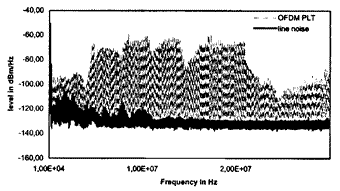
Figure 16: Conducted emission on a low-voltage
network with modems and without interference
Figure 17: Conducted emission on a low-voltage
network with modems and with interference
The result shows a high
signal/noise ratio (SNR) margin in the
presence of stationary noise. This means
that the OFDM carriers should probably
be reduced. But when the hair-drier is
in use the margin is very small.
To summarise, this initial
research in EMC on indoor PLT identifies
the real problems to be solved for the
development of PLT. Concerning interference,
the standardisation defined solely for
conducted emission below 30 MHz is not
sufficient for PLT. The measurements in
conducted emission must be stabilised.
The use of LISN (standardised according
to EN 55022) is not realistic with the
use of PLT modems because the link is
not bi-directional. In terms of immunity
and radiated emission, measurements have
to be made on PLT. Modulation techniques
and error correction codes should allow
the low-voltage network to be used as
a medium for broadband transmission. The
aim is to find an acceptable compromise
between a sufficient emission power level
(good transmission quality) and a low
emission power level so as not to perturb
the environment.
Standardisation
There is only one standard
in this area, EN 50065 [1], taking into
account frequencies from 3kHz to 148.5kHz,
created by CENELEC and comprising a part
of the harmonised standards of the European
EMC directive. One of the hindrances to
the development of PLT is uncertainty
surrounding the regulations (standard,
limit values, etc.) to be applied in terms
of EMC.
It is readily understood
that high bit rate transmission over an
unshielded, untwisted pair can generate
high levels of electromagnetic interference.
Current work in standardisation for defining
specific limits for these systems is advancing
slowly because of divergent points of
view and interests (development of PLT
transmission systems vs. protection of
radio- electric services for use under
30 MHz).
Several standardisation
bodies are working on the domain: CENELEC
TC 205, 210, and 215; ETSI, and CEPT.
A common project including these bodies
began work at the beginning of the year
2000 under the name ETSI Project PLT.
Panels are working in parallel and are
now co-operating on a PLT forum.
In terms of EMC, two
major approaches ("chimneys"
and "flat") are under study,
both with advantages and disadvantages.
Conclusion
Preliminary France Télécom
R&D research in the power line technologies
field is very interesting. With a low-voltage
network, measurements can be taken when
voltage is present on the line with reliable
results that represent a real-life situation.
The use of twisted-pair cable can generate
a new way to transmit PLT. Work in actual
domiciles will be carried out in future
field trials.
Our EMC measurements
disclose the problems to be solved for
the development of PLT in terms of conducted
and emitted interference. The goal of
subsequent research will be to find an
acceptable compromise between good transmission
and low interference in terms of emission
power, with a possibility of accelerating
the PLT standardisation process.
Finally, the initial
tests on IP transmission with real Internet
services and a bit rate in the Mbit/s
range point the way to future field trials
with actual customers in a real environment.
This will be the next step for France
Télécom R&D in the domain
of PLT.
Authors
0. Bouffant, D. Le Bras,
H. Le Cozic, P. Gay, M. Le Dizès,
P. Legaud, J-M. Auzizeau, G. Térol
France Télécom - France
Reference
[1] CENELEC EN
50065-1 "Signalling on Low-Voltage
Electrical Installations in the Frequency
Range 3kHz to 148.5kHz - Part 1: General
Requirements, Frequency Bands, and Electromagnetic
Disturbances."
This
paper was delivered at the 49th seminar
IWCS
Atlantic City, USA - November 2000
Printed by courtesy of IWCS - © IWCS
2000 |



