TECHNICAL ARTICLE:
| Crosstalk Coupling between Cable Pairs | ||||||||||||||||||||||||
| By: Mohammed M Al-Asadi and Alistair P. Duffy - De Montfort University, UK and Kenneth G Hodge, and Arthur J Willis - Brand-Rex Ltd, UK |
||||||||||||||||||||||||
Abstract A new approach to the modelling and simulation of electromagnetic coupling between communication channels is presented in this paper. The technique is used for the prediction of cross-talk in cable pairs. It consists of two parts. The first is the use of the Transmission Line Matrix (TLM) method, where both source and victim pairs in a communication channel are modelled and voltages and currents are calculated. The second part treats the twisted wire as a helical antenna and the radiated fields from the source cable impinging on the victim cable are calculated. The induced voltages and currents between the wires of the victim pair are then calculated. Optimisation of the method, where windowing is used to reduce the overall-computing burden is also demonstrated. Results obtained for the simulation of a channel of varying lengths are compared to experimental data. The comparison of results shows encouraging agreement. Introduction The next generations of structured wire cables and cabling, such as Category 6 (UTP and STP) and Category 7 (STP) cables, are now emerging in the open market. Draft performance specifications are pushing traditional design methodology and cable-making processes further than ever before. There are a number of potential sources of noise in such transmission systems. These range from general EMC issues, like interference generated by lightning [1], to proximity to power transmission lines and railway lines [2]. However, noise is also, and primarily, caused by close proximity of cables and subsequent coupling of radiated electromagnetic fields from adjacent pairs [3], this is the primary focus of this paper. Near end crosstalk, NEXT, and far end crosstalk, FEXT, are both measures of coupled signal strength between a source pair (the disturbing pair) and a victim pair. One result is gained from analysis of near end energy coupled into the victim pair and the other from the far end coupled energy. The magnitude of the electromagnetic interference varies significantly with a number of factors, including the geometries of the cable pairs [4], the materials used and the energy characteristics of the transmission spectrum. In general, the electromagnetic coupling between external interferers and intra-system issues has attracted some interest [5]. In addition, attention has also focused on the electromagnetic coupling between signals transmitted on pairs of multi-conductor transmission lines [6]. The latter is usually referred to as cross-talk between cable pairs. Three-dimensional computational methods, such as Finite Element Method (FEM) [7], and Transmission Line Matrix (TLM) method [8] are extensively used for the analysis of electromagnetic coupling. Furthermore, analytical solutions based on field radiation of antenna theory are also used for the prediction of field coupling to transmission-lines [9]. In some cases, two methods such as FEM and TLM are employed in the same model [10], while others have combined both modelling and measurements for the prediction of field coupling [7]. While some approaches have used three-dimensional modelling methods, others have used the calculation of both inductance and capacitance matrices for a multi-conductor transmission lines [11,12]. The objects of this interest have included the investigation of cross-talk between short cables lengths [13], the practical effects of cross-talk [14] and the problems of investigating cross-talk coupling from multiple sources [15]. In this paper, two approaches are combined for the calculation of cross-talk coupling between pairs of a communication cable. These are the one-dimensional TLM approach and the antenna theory [16]. The advantage of such a method is that it allows physical representation of the system but does not incur the memory and run-time overheads of a full 3D solution. For example, it allows the incorporation of such channel specific phenomena as termination changes and handling effects [17]. The development of this method is described in the next section. Method development In reference [16], a detailed description of the model, including the capacitive coupling between communication cables was presented. The stages of the operation of the model presented in [16] are illustrated in the calculation of the electromagnetic coupling between two communication channels illustrated in Figure 1:
where a1, a2, a3 and a4 are the four incident voltages at the four ports of the two pairs and b1, b2, b3, and b4 are the reflected voltages at the corresponding ports.
The models progress one iteration and the process starts again. The next sub-section describes the inclusion of the inductive coupling into the previous model allowing a complete electromagnetic simulation to be achieved. Inductive coupling introduction
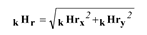
where kHrx and kHry are the resultant fields in both x and y directions calculated at the k th time step and given in equations 8 and 9 of the previous model. The cables are assumed to be directed along the z direction of the plane. The induced current at both wires can be calculated as illustrated in Figure 2 (where D is the separation between the wires).
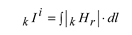
The induced current Ii as a result of the radiated field Hr can be calculated using the following equation:
Using the dimensions of the cable pair, the above equation can then be simplified to:
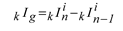
At the connection, (g), between any two adjacent TLM nodes, (n) and (n-1), of the victim pair cable, we have two current values induced as a result of the radiated magnetic fields at both nodes, as illustrated in Figure 3.
The induced current between the two wires of the victim pair can be obtained as:
The induced current, along with the induced voltage, is illustrated in Figure 4.
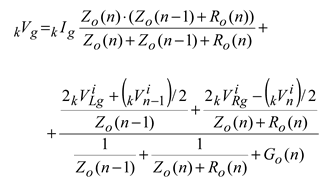
The voltage at the connection g may then be obtained as:
The current of the victim pair node can then be obtained as:
The incident and reflected voltages of the TLM model of both source and victim pairs can then be calculated as described in references [16] and [17]. At this stage, voltages and currents induced at any TLM node along the victim cable pair, resulting from radiated fields generated from the travelling wave on the source pair, can be calculated. From the TLM model of both the source and the victim cable pairs, both incident and reflected signals at all four ports can be calculated. From those voltages, both Near-End Crosstalk (NEXT) and Far-End Crosstalk (FEXT) can be calculated using the following equations respectively:
The next section deals with an enhancement to the method which improves the resource requirements of the implementation of the proposed method. Windowing of the radiated field calculations
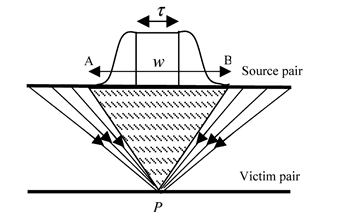
The values of the currents induced from the nodes before A and after B are negligible compared to those at any point between A and B. Therefore, the radiated fields at point p of the victim cable pair are calculated from the summation of those generated by currents travelling between nodes A and B. Using the lay length of the source pair, the unit length of the TLM model, and the width of the window, w, the nodes between which the window of the calculation is located can be determined. Tests showed that a window width of 3? is adequate. Model implementation For the investigation of both capacitive and inductive coupling, the following steps need to be followed in addition to those stated in section 2.
Having described the development of the model and the method of implementation, it is used for the investigation of the crosstalk coupling between communication channels under different working conditions. Validation, implementation and results This section combines the validation of the model and the implementation of the model for the prediction of coupling between two transmission channels spaced at a distance S as in Figure 1. The effect of the windowing described in "Windowing of the radiated field calculations" section is also investigated. The model is then used for the prediction of electromagnetic coupling between two twisted pair cables in a single cable bundle. Results are compared against those obtained using a 3D TLM model, and measurements and results obtained from reference [13]. Validation against 3D TLM
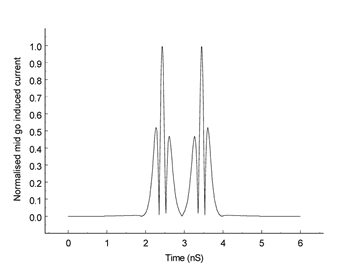
The induced current on the victim pair as a result of sending a short pulse of 2nS, was determined. The normalised value is plotted against time as illustrated in Figure 7.
Using the same channel, the induced current as a result of radiation generated by the same pulse was calculated using the new method. The normalised value was then plotted as in Figure 8. The comparison supports the operation of the proposed method.
Implementation for single pair channels
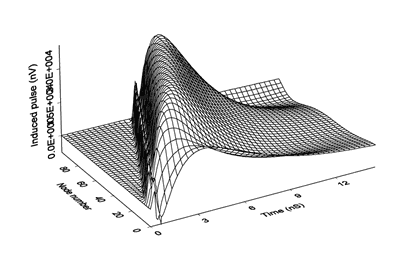
To illustrate the effects of different spacing between neighbouring channels on the induced voltage, the response of the same pulse is calculated when the spacing is increased to 25cm. This is illustrated in Figure 10.
To illustrate the ability of the new approach the handle any sort of travelling signals the coupled signal on the victim pair was calculated as a result of a double exponential wave travelling on the source channel. The separation is 5cm. The coupled voltage is plotted as a function of time and along the victim channel as
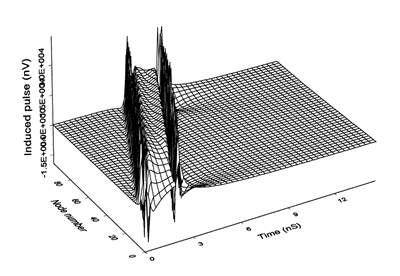
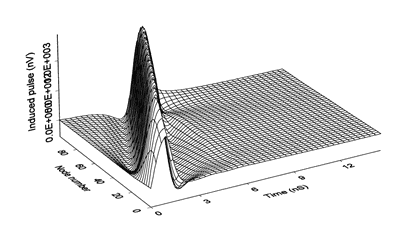
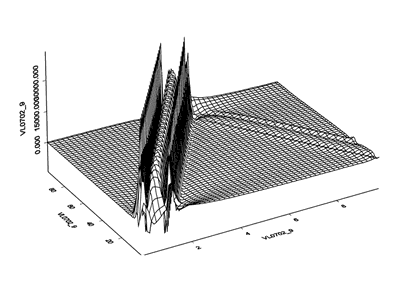
Windowing is further illustrated with a pulse of 2nS injected into the source pair. The termination of both cables were no longer matched (with a 5 per cent difference), thus introducing reflections. The induced voltage distribution along the victim pair was computed without using windowing and illustrated as in Figure 12. Using Windowing of 6nS width, the induced voltages along the victim pair are also calculated and plotted as in Figure 13.
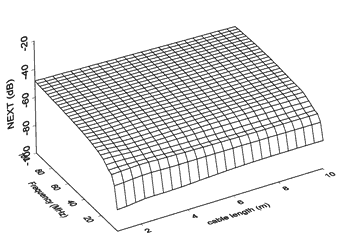
Both figures show excellent agreement. They also show a small reflection generated by the mis-matching at the far end of the cables. The run-time of the program had been reduced dramatically with windowing to around half of the time required for running the program without windowing. Most of the above results were obtained with a large separation between the coupled channels. To illustrate the calculation of the cross-talk between pairs of the same bundle, a cable of four twisted pairs was modelled. The pair dimensions were: copper diameter 0.53mm and distance between centres of the conductors including dielectric of 0.96mm. The twisting periods of each pair were, 22mm, 20mm, 19mm and 17mm. Using a single pulse travelling on the 1st pair of the cable, the near end cross-talk induced on the other pairs was calculated. Table I show the calculated values of a 10m cable obtained using the new method (between pairs 1 and 2) compared to typical measured values of a 100m cable and the standards limits (for reference).
Table I: Calculated and measured near end cross talk The calculated NEXT values for channels of different lengths from 1m to 10m length are then plotted as function of the frequency and the channel length as illustrated in Figure 14.
Discussion and conclusion A method, combining analysis and modelling, for the calculation of crosstalk between communication cable pairs has been presented. This approach was used to calculate the electromagnetic coupling including both electric and magnetic fields between two communication channels. The effects of channel separation, pulse duration and terminations on the coupled pulses were illustrated. The coupling of different pulse shapes was also illustrated using a double exponential pulse transmitted on the source channel. The method then validated against a 3D TLM electromagnetic solver. The mid-go current on the victim channel was calculated using both the 3D solver and the new approach. Both normalised currents illustrate the same shape. This indicates the validity of the method. While the proposed technique has significant memory and run-time savings over conventional 3D analysis, the simulation of long channels could be time consuming. In order to reduce this, a windowing technique was introduced in order to minimise the time required. Near End Crosstalk (NEXT) was then calculated between two pairs of a four-pair cable. Results were obtained for different channel length and at different frequency of operation. Although a 100m channel was not simulated, the results presented are encouraging. The frequency dependence of the NEXT was also demonstrated. It can be concluded that a flexible, effective and realistic approach was presented here that can be used for the calculation of crosstalk coupling between communication channels. The approach can also be used for the investigation of the effects of cable irregularities on crosstalk calculations. References [1] B. Kordi, R. Moini, and F. Rachidi, 2001, “Modeling an inclined lightning return stroke channel using antenna theory”, Proceedings of the 14 th Zurich EMC conference, pp. 331-334. This paper was delivered at the 50th seminar IWCS De Montfort University
|
||||||||||||||||||||||||
|
||||||||||||||||||||||||