Abstract
This article considers the influence of attached fiber optic cable on aeolian vibration of ground wire. To study the self-damping characteristics, the power dissipation of a vibrating ground wire has been measured for these three cases:
- Bare ground wire;
- Ground wire with a lashed cable;
- Ground wire with a wrapped cable.
|
| Introduction
As the demand of industry and consumers for voice, video, and data transmission becomes ever more insistent, telecommunication firms are scrambling to satisfy it. With overhead power line networks already in place, Optical Attached Cables (OPAC) are an economical and fast way to install end-to-end optical aerial cable networks.
AD-Lash cable system
The AD-Lash system is one of the concepts for optical attached cables. The AD-Lash cable is fixed with a special lash band to either the ground wire or phase wire (Figure 1). |
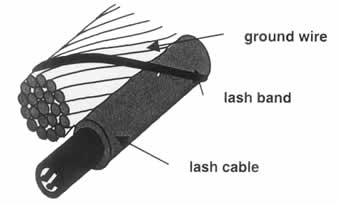 Figure 1: AD-Lash cable system
 |
The AD-Lash system solution consists of dielectric fiber optic cable, special lash band, and an optimized installation procedure using special machinery. The system has been developed for installation along overhead power lines. The standard AD-Lash cable is a central buffer tube design with up to 48 fibers (Figure 2). The lash band is completely weatherproof and reinforced by glass yarns. A radio-controlled (or manual) lashing machine (Figures 3 and 4) winds the band around the messenger wire and the AD-Lash cable so that the cable is permanently fixed underneath the phase wire or the ground wire. With the AD-Lash system it is possible to install up to 25 km per day. |
Figure 2: AD-Lash cable and lash band design
|
Figure 3: Radio Controlled Lashing Machine
|
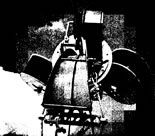
Figure 4: Manual Lashing Machine |
Wrapped cable
The wrap is an alternative OPAC solution. With this system the optical cable, typically a stranded loose tube design, is wound directly around the messenger wire (Figures 5 and 6).
Aeolian vibration
The phenomenon of aeolian vibration is well known from transmission lines. The cause is vortex shedding at the ground wire/conductor (Figure 7) in low turbulent air that appears especially at wind velocities between 0.5m/s and 7m/s. |
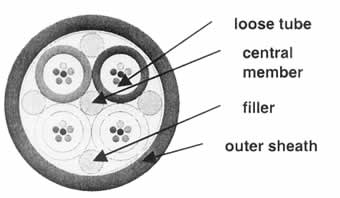 Figure 5: Wrap cable
 |
The vibration of wire is perpendicular to the direction of the wind. Aeolian vibration may give rise to fatigue failure of ground wire and conductor. The frequency of aeolian vibrations depends on the wind velocity and wire diameter and is given by:

where:
- f is the frequency of the vibration,
- S the Strouhal-number (0.185),
- V the wind velocity, and
- d the diameter of the wire.
|
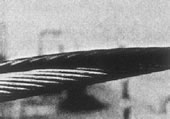
Figure 6: Wrap cable wound around a messenger wire |
| For the critical range of the wind velocity between 0.5m/s and 7m/s, the frequency of the vibration is shown in Figure 8 for two wires with different diameters. |
Figure 7: Vortex shedding
|
Measurement of aeolian vibration
As noted above, for study of the self-damping characteristics of ground wire both with and without an attached cable, the power dissipation was measured in three cases bare ground wire. ground wire with a lashed cable, and ground wire with a wrapped cable. The ground wire used in the experiment has a diameter of 9.0mm (seven stranded single wires, each 3.0mm in diameter), and the lashed optical cable has a diameter of 5.9mm. A manual lashing machine (Figure 4) was used to install cable over the full length of the ground wire sample.
The lashing machine fastened the cable underneath the ground wire by means of two lash bands that were wound helically around the ground wire and cable. The two ends of the cable were secured to the ground wire by clamps (Figure 9), and the cable part beyond the clamps was cut. |
Figure 8: Critical range of Aeolian Vibration
|
The wrapped cable with an outer diameter of 8.4 mm was manually wound around the ground wire over its entire length with a pitch of 0.5m. During the wrapping procedure the cable was pulled by a tension of about 80N in order to achieve a tight wrap (Figure 10). The end of the wrapped cable was secured to the ground wire by the use of clamps. |
Figure 9: Clamps at the end of a ground wire
|
The decay method was used for measurement of the self-damping characteristics. The ground wire was tensioned during the tests to a nominal 6.8kN between two terminations with a span length of 29.2m. An electrodynamic shaker was connected to the specimen at one end of the span to provide a driving force. For the test the span was brought into the resonance at tunable frequencies. Different measurements were taken at the frequency range between 6 and 100Hz at three vibration angles: 5°,10°, and 20°.
A good way to describe the damping characteristics is by means of the damping ratio h which gives the ratio between the energy Ediss dissipated per cycle and unit length and the maximum kinetic energy Ec,max per unit length.
|
Figure 10: Wrapped cable on a ground wire
|
Measurement results
Measurements of the self-damping characteristics of ground wire with OPAC show that OPAC increases the self-damping capacity of ground wire. The damping ratio of a ground wire with AD-Lash is ten times higher than that of bare ground wire or ground wire with wrapped cable (Figures 11a, 11b, and 11c).
|
Figure 11a: Influence of attached cables on the self-damping characteristics of the ground wire at the vibration angle 5° |
|
Figure 11b: Influence of attached cables on the self-damping characteristics of the ground wire at the vibration angle 10° |
|
Figure 11c: Influence of attached cables on the self-damping characteristics of the ground wire at the vibration angle 20° |
Discussion
If two objects are continuously connected and one or both is induced to oscillate, there will be no phase difference between the oscillations of both objects. If the connection is not so rigid, and one of the two objects is induced to oscillate, the phase of the oscillation of one is different from that of the other. This occurs when the two objects have different masses and dimensions.
The difference causes a faster dissipation of the oscillation energy of the entire system. During measurement-taking, lash cable and messenger wire will beat against each other. This beating causes friction between them, and an increase in self-damping capacity. This means that a ground wire with AD-Lash has higher self-damping capacity than a bare ground wire. The difference in self-damping characteristics between the AD-Lash system and the wrapping system has its basis in the better connection between wrap cable and messenger wire.
Conclusions
- Attached cables improve the self-damping capacity of ground wire;
- Self-damping of ground wire with AD-Lash is about ten times higher than the self-damping of ground wire with wrapped cable;
- For ground wire with an AD-Lash system, vibration damping systems are not necessary;
- The additional load on the tower due to the weight of the AD-Lash cable is compensated by the better self-damping characteristic of ground wire with OPAC, especially AD-Lash;
- The critical range of aeolian vibrations is reduced with installation of an attached cable, especially the AD-Lash system.
References
E.S. Doocy, A.R. Hard, C.B. Rawlins, R. Ikegami,"Wind- Induced Conductor Motion," Electric Power Research Institute (1979)
Guide on Conductor Self-Damping Measurements. IEEE Standard 563-1978
Guide on Conductor Self-Damping Measurements. CIGRE SC22 WG01, Electra No. 62
This paper was delivered at the 49th seminar IWCS
Atlantic City, USA - November 2000
Printed by courtesy of IWCS - © IWCS 2000
|