Abstract
Optical fibre with a chromatic dispersion value of 8 ps/nm/km at 1550 nm is a good compromise for transmission systems working at Terabit/s rate. Such a value is sufficiently high to avoid non-zero dispersion shifted fibres (NZDSF) limitations and sufficiently low to avoid single mode fibres (SMF) limitations. Moreover, it allows an interesting trade-off between the chromatic dispersion slope and the effective area. Fibre with optimised propagation characteristics has been realised. This fibre, TeraLight™, has been used in a 1.5 Tbit/s system (150 channels at 10Gbit/s in both C and L band with a 50GHz channel interspacing) and in a 1.28 Tbit/s system (32 channels at 40 Gbit/s). It is adapted for use in the S wavelength band.
Introduction
Terabit transmission systems through optical fibre are about to become a reality. With an intensive occupancy rate of the C+L bands, between around 1530 and 1610nm, transmission capacities as high as 3 Tbit/s have been obtained [1]. Even higher capacities could be reached with the use of enhanced C and L bands and with the opening of a short wavelength band, S, typically between 1450 and 1500nm.
The choice of the most suitable transmission fibre to meet high capacity and upgradability requirements of dense wavelength division multiplexed (DWDM) transmissions is one of the main issues in optical transmission systems. Dispersion shifted fibre (DSF) exhibits a too-low dispersion that enhances the impact of cross-nonlinearities and mainly four wave mixing (FWM). Standard single mode fibre (SMF), with its large 17 ps/nm/km dispersion value in the 1550nm window, is more suitable for DWDM transmissions, as the large dispersion reduces drastically the impact of cross-nonlinearities [2].
Nevertheless, at 10 Gbit/s per channel and above, over terrestrial transmission distances (typically 500 km), such a fibre requires dispersion compensation. Dispersion compensating fibre (DCF) can be used for this purpose, but it impacts both on the system cost and, due to its large attenuation, on the signal-to-noise ratio (SNR) at the end of the transmission. There must be a trade-off in terms of chromatic dispersion between DSF and SMF, which will minimise the required amount of dispersion compensation while still providing an efficient cross-nonlinearities reduction.
First-generation non zero dispersion shifted fibres (NZDSF) were expected to meet these requirements, but their local dispersion is still too low and cross non-linear effects are still damaging at today's channel spacing [3, 4]. A solution to decrease these cross-nonlinear impairments is to increase the effective area of the NZDSF. In fact, such a large effective area NZDSF (LEA-NZDSF) has already shown good transmission performance [5], but at the expense of a high chromatic dispersion slope.
A new transmission fibre, optimised for present and future needs, seems to be an important challenge. For such optimisation, careful analysis of system requirements as well as a good knowledge of fibre design capabilities is needed. In this article we first present a detailed analysis of system requirements for transmission fibre in the case of DWDM high-bit-rate transmission. We then present extensive design results to find best-suited index profiles when system considerations are taken into account.
System requirements
The aim of this section is to focus on the value of the local dispersion of the transmission fibre to find out its optimal value. This is done by numerically varying the dispersion and optimising in each case the dispersion management. Dispersion management must indeed be carried out carefully, considering its critical importance on transmission performance [6].
Simulation parameters
The simulated transmission link is shown in Figure 1. At the transmitter side, 32 randomly decorrelated channels, 100 GHz spaced, modulated at 10 Gbit/s with a non-return to zero (NRZ) modulation format, are generated with wavelengths ranging from 1535.04nm to 1559.78nm that fall within the ITU-T recommended grid.
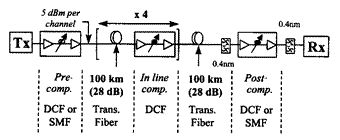
Figure 1: Simulated transmission set-up
The transmission line consists of five 100 km spans of transmission fibre whose chromatic dispersion is to be optimised, and of six dual-stage optical amplifiers. Such an architecture allows insertion of dispersion compensation between the two stages with reduced impact on the noise figure (NF) of the total amplifier. In our simulations, the power per channel at the output of the amplifiers is set to 5 dBm.
Noise is taken into account by an accurate model that calculates the impact of the internal loss due to the dispersion compensation on the total NF. As an example, when internal loss is set to 0 dB, the NF of the amplifier is 5 dB; and when the loss is 11 dB (which corresponds to the DCF needed to compensate exactly for 100 km of SMF), the NF is 6.5 dB.
At the end of the transmission, the receiver power sensitivity is evaluated for a bit error rate (BER) of 10-10 and compared to the sensitivity without transmission to obtain the transmission penalty. Characteristics of DCF correspond to commercially available data: dispersion at 1550 nm is -80 ps/nm/km, dispersion slope is -0.12 ps/nm2/km; and attenuation is 0.6dB/km. Concerning the transmission fibre, its zero dispersion wavelength is varied from 1300nm to 1550nm, by 50-nm steps. This corresponds to dispersion values at 1550nm ranging from 0 to 17.5 ps/nm/km by 3.5 ps/nm/km steps. In each case, the dispersion management of the link is optimised by considering in line 90% span dispersion compensation7 and optimising the amount of pre- and post-compensation by 200 ps/nm steps.
Then, to focus only on the impact of the dispersion of the transmission fibre, the dispersion slope is set to 0.07 ps/nm2/km and the effective area to a constant 50 µm2, whatever the dispersion. To finish, note that the span budget is a large 28 dB to comply with field requirements.
Results and discussion
Dispersion management is optimised for each chromatic dispersion of the fibre by selecting a value of pre-compensation between -100% and 100% of the cumulated dispersion of one fibre span, and sweeping the value of the post-compensation from -2000 ps/nm to 2000 ps/nm by 200-ps/nm steps. In each case the sensitivity penalties for a 10-10 BER are calculated for the 32 channels, as well as the mean penalty and the difference between the best and worst channel sensitivities. We choose as the best map the one that leads to both the lowest mean penalty and the lowest difference between the best and worst channel sensitivities. The results are shown in Figure 2 for a dispersion of 17.5 (2a), 7 (2b), and 3.5 ps/nm/km (2c). The optimal dispersion map is reported in each case, plotting the cumulated dispersion for channel 1 (dashed) and channel 32 (full) as a function of the distance. The corresponding sensitivity penalties for a BER of 10-10 are plotted for each of the 32 channels. Note that, when dispersion is zero, error floors are obtained due to the FWM. The mean penalty and the difference between the best and the worst channel sensitivities decrease as dispersion increases, as expected [2], because of the lower impact of cross nonlinear effects.
Figure 2: Best maps obtained after dispersion management optimisation and corresponding channel penalties for a 10-10 BER, for various values of fibre dispersion at 1550nm
To see more clearly the evolution of the penalty as a function of the chromatic dispersion of the fibre, we have plotted in Figure 3 the best, the worst, and the mean penalties for the 32 channels as a function of the fibre dispersion. Once again, the beneficial impact of high local dispersion to suppress cross-nonlinear effects can be observed. If we consider only the mean penalty, it can be seen that a minimum is reached for 14 ps/nm/km; and that, above this value, it increases again because of the SNR degradation due to compensation modules.
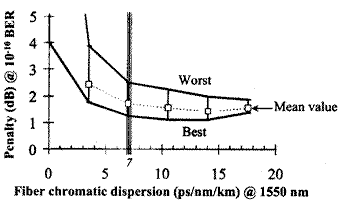
Figure 3: Results obtained as a function of fibre chromatic dispersion. The effective area is a constant 50 µm2
Nevertheless, a chromatic dispersion of 7 ps/nm/km looks like a threshold value. While worst sensitivity penalties remain below 2.5 dB for dispersion values above 7 ps/nm/km, they dramatically increase for dispersion values below 7 ps/nm/km. Consequently, 7 ps/nm/km is the lowest value to guarantee an efficient suppression of cross-nonlinearities. This value of dispersion is an interesting choice for various reasons:
- First, the amount of needed DCF is more than twice as low as for SMF, which reduces both the compensation loss and cost;
- Second, other optical elements, such as optical add-and-drop multiplexers, can then be inserted inside the dual-stage amplifiers of the link while keeping the inter-stage loss to an acceptable level;
- Third, the reduced length of DCF also leads to reduced polarisation mode dispersion in the link, which is of crucial importance at high bit-rate.
In summary, we demonstrate here that there is a good trade-off around 7-8 ps/nm/km for the chromatic dispersion of the transmission fibre. Such a dispersion guarantees an efficient suppression of cross-nonlinearities in DWDM systems while strongly reducing the DCF length needed in the compensation architecture of the link.
Fibre design
Which fibre propagation characteristics would be obtained for a 8 ps/nm/km chromatic dispersion requirements in the 1550 nm window? We will here study fibre refractive index designs with such a chromatic dispersion value and compare this new family to the preceding ones.
Key propagation characteristics
Chromatic dispersion is not the only parameter to be considered when designing a fibre refractive-index profile. First, the flattest variation of the chromatic dispersion is required. Chromatic dispersion slopes at 1.55 µm, C', which is the derivative of chromatic dispersion with wavelength needs to be minimised for a more efficient dispersion management over the amplifying bands. The second propagation characteristic (at 1.55 µm) to take into account is the effective area, Aeff. Effective area is a key parameter in describing optical nonlinearities, and a large effective area is an efficient way to reduce non-linear effects [8].
Teralight (TM) Fibre
The fibre refractive-index needs also to ensure good behaviour of the fibre in cable. We consider three parameters at 1.55 µm: bending and micro-bending losses, which need to be minimised; cut-off wavelength, which needs to ensure single-mode behaviour of the fibre in the operating channel's wavelength; and, last but not least, fibre loss needing to be equivalent to preceding generations, i.e. around 0.2 dB/km in the 1550nm window.
To compute all these parameters, we use a program that solves the scalar wave equation for arbitrary index profiles and wavelength, using the Sellmeier formula for ?-dependence of silica, gemianium-, and fluorine-doped silica refractive index [9, 10]. Once the propagation constant (or effective index) and fundamental mode field distribution is known, we can compute: mode field diameters Petermann 2 and 2, effective area Aeff, chromatic dispersion C, and chromatic dispersion slope C'. We can also compute bending loss for any radius using the radiation model [11] and a micro-bending sensitivity parameter Sµc that we defined [12]. Finally, we also look at the tolerance of propagation characteristics to small fibre-parameter deviations. Small changes in propagation characteristics with changes in core radius and core-cladding refractive index will insure good control and good reproducibility of chromatic dispersion during the manufacturing process.
Results and discussion
Optimising both key parameters, dispersion slope C' and effective area Aeff, together with low loss and good cabling behaviour, is difficult to achieve. High effective areas are usually associated with high dispersion slope [13].
As a reference, we first studied simple step-index design. As expected, step design is interesting for high chromatic dispersion values and results in a too-small effective area when chromatic dispersion is below 10 ps/nm/km. We then focused on the well-known trapezoid + ring profile shape (Figure 4), which presents a more manageable trade-off between effective area and slope values and which offers the technical advantage of a well-controlled process with loss level equivalent to that of SMF.
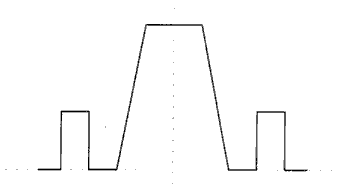
Figure 4: Representation of the trapezoid + ring refractive index profile shape
This type of profile has six adjustable parameters: height of central trapezoid and ring, width and position of ring, trapezoid shape and radius. All these parameters are scanned to find the family of index profiles leading to set chromatic dispersion values C0, that is, 0 to 16 ps/nm/km by a 4 ps/nm/km step.
In a given family, we first study the influence of bending loss and cut-off wavelength. These two parameters have a dramatic influence on possible effective area and dispersion slope values. This is illustrated on Figure 5 for chromatic dispersion C0 set to 8 ps/nm/km. Each curve of Figure 5 represents the smallest available dispersion slope as a function of effective area but for several given bending loss values. Those curves allow us to follow exactly how the slope changes as effective area and bending loss values are increasing.
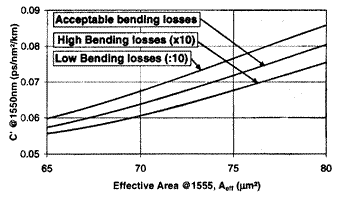
Figure 5: Chromatic dispersion slope as a function of effective area obtained for a chromatic dispersion, C, of 8 ps/nm/km and constant .
It is clear that, the higher the bending loss level, the smaller the dispersion slopes. But too-large bending loss will lead to poor "cable-ability." The impact of cut-off wavelength is quite similar to that of bending loss; that is, the higher the cut-off wavelength, the smaller the slope. But cut-off value is also limited to ensure single-mode behaviour in cable. So optimum bending loss and cut-off wavelength values have to be carefully chosen to allow the best trade-off between effective area and slope, together with good behaviour in the cable.
Once optimum bending loss and cut-off wavelength values are chosen to ensure good behaviour in cable, we now study the impact of chromatic dispersion value on the trade-off between effective area and slope. This is illustrated by the curves of Figure 6, which shows how dispersion slope is limited by effective area for different chromatic dispersion values.
The curves show several key features. It first appears that increasing the chromatic dispersion values allows a better trade-off between effective area and slope. For example, changing chromatic dispersion from 4 to 8 ps/nm/km allows an effective area increase of about 7 µm2, when the slope C' is around 0.06 ps/nm2/km. The chromatic dispersion slope also decreases from 0.07 to 0.058 ps/nm2/km, when effective area Aeff is around 65 µm2.
The improvement of the trade-off between effective area and slope is noteworthy in the large effective area domain. Indeed, as shown in Figure 6, the variation of C' with Aeff decreases when the chromatic dispersion increases. For an effective area of 80 µm2, changing chromatic dispersion from 4 to 8 ps/nm/km allows a chromatic dispersion slope decrease of 0.022 ps/nm2/km, from 0.102 to 0.080 ps/nm2/km. Chromatic dispersion values over 8 ps/nm/km conduce to a more interesting trade-off between effective area and slope, but we note that in this case system design is no longer optimised due to DCF in the compensation architecture of the link.
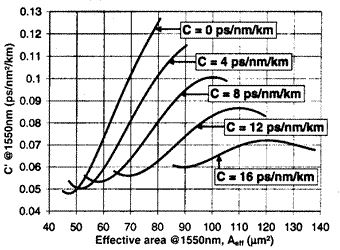
Figure 6: Chromatic dispersion slope as a function of effective area for a set of chromatic dispersion targets (0, 4, 8, 12, and 16 ps/nm/km), constant, and bending loss @1550 nm (ensuring production of fibres with good behaviour in cable)
We now focus on solutions with an effective area of about 70 µm2, which is a good trade-off to reduce fibre nonlinearities while maintaining a reasonable chromatic dispersion slope. Figure 7 shows the chromatic dispersion slope as a function of the chromatic dispersion for an effective area of 65 µm2. It illustrates the huge impact of chromatic dispersion. Indeed, attractive chromatic dispersion slopes lower than 0.06 ps/nm2/km are obtained for chromatic dispersion values over 7 ps/nm/km. A chromatic dispersion value of 8 ps/nm/km is, then, a good compromise from a fibre design point of view.
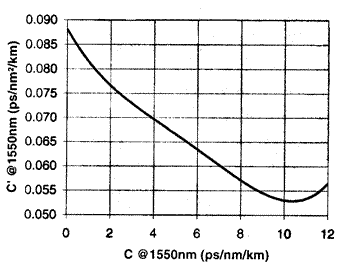
Figure 7: Chromatic dispersion slope as a function of chromatic dispersion for an effective area of 65 µm2, constant ?c, and bending loss @1550 nm (ensuring production of fibres with good behaviour in cable)
Experimental validation
A novel type of fibre, with local dispersion around 7-8 ps/nm/km and effective area around 65 µm2, was designed after these numerical results. Fibre results are in very good agreement with our numerical predictions. Micro-bending loss is comparable to that of standard fibres, and cable trials have shown very good behaviour.
The efficient suppression of cross-nonlinear effects was confirmed in a record transmission experiment of 150 channels at 10 Gbit/s over 400 km [14]. BER as low as 10-15 have been achieved with channel spacing as low as 50 GHz. A transmission of 32 channels at 40 Gbit/s over 300 km has also been demonstrated [15].
Conclusions
A chromatic dispersion value of 8 ps/nm/km is a good compromise. It is sufficiently high to avoid NZDSF limitations and sufficiently low to avoid SMF limitations, and it allows an interesting trade-off between effective area and slope. Such propagation characteristics have been experimentally validated and led to development of a new fibre, TeraLight™, with the expected propagation characteristics and cabling behaviour. This fibre has been used in a 1.5 Tbit/s system (150 channels at 10 Gbit/s in both C and L band with a 50 GHz channel interspacing) and in a 1.28 Tbit/s system (32 channels at 40 Gbit/s). It is adapted for use in the S wavelength band.
References
[1] T.N. Nielsen et al., "3.28-Tbit/s (82x4OGb/s) Transmission Over 3x100km Non-zero-Dispersion Fibre Using Dual C- And L- Band Hybrid Raman/Erbium-Doped Inline Amplifiers", OFC'00, postdeadline Paper PD23, Baltimore, Maryland (2000).
[2] S. Bigo et al., "Investigation of Cross-Phase Modulation Limitation over Various Types of Fibre Infrastructures", Photonics Technol. Lett., Vol.11, N°5 (1999).
[3] A. Bertaina et al., "Investigation of the Limitations of WDM Typical Terrestrial Transmissions over NZDSF and SMF", Tech. Dig. ECOC'98, Paper TuC11, Madrid, Spain (1998).
[4] L.D. Garrett et al., "Experimental Comparison of WDM System Capacity in Conventional and Non-zero Dispersion Shifted Fibre", Tech. Dig. OAA'98, Paper TuB2, Vail, Colorado (1998).
[5] S. Tsuda and V.L. da Silva, "Transmission Of 40 NVDM Channels at 10 Gbit/s over 6x100 km of LEAF Fibre with Dispersion Compensation at Tx and Rx Terminals", Tech. Dig. ECOC'99, Paper MoC2.3, Nice, France (1999).
[6] A. Bertaina et al., "Experimental Investigation of Dispersion Management for an 8 X 10-Gbit/s WDM Transmission System over Non-zero Dispersion-Shifted Fibre", Photonics Technol. Lett., Vol.11, N°8 (1999).
[7] G. Bellotti and S. Bigo, "Cross-Phase Modulation Suppressor for Multispan Dispersion-Managed WDM Transmission", Tech. Dig. ECOC'99, Paper TuC2.4, Nice, France (1999).
[8] B. Biotteau et al., "Enhancement of Soliton System Performances by Use of New Large Effective Area Fibres", Electron. Lett., Vol.31 (1995).
[9] J.W. Fleming, "Material Dispersion in Lightguide Glasses", Electron. Lett., Vol.14 (1978).
[10] S. Kobayashi et al., "Refractive-Index Dispersion of Doped Fused Silica", TOOC'77, Paper B8-3 (1977).
[11] A. W. Snyder and J. D. Love, "Optical Waveguide Theory", Chapman and Hall, New York (1983).
[12] K. Petermann and R. Kuhne, "Upper and Lower Limits of the Micro-bending Loss in Arbitrary Single Mode Fibres", Journal of Lightwave Technol., 1986, Vol. LT4, pp. 2-9 (1986).
[13] P. Nouchi, "Maximum Effective Area for Non-zero Dispersion-Shifted Fibre", OFC'98, Paper TbK3, San Jose, California (1998).
[14] S. Bigo et al., "1.5 Terabit/S WDM Transmission of 150 Channels at 10 Gbit/s over 4 x 100km of TeraLight™ Fibre", ECOC'99, postdeadline Paper PD2-9, Nice, France (1999).
[15] S. Bigo et al., "1.28 Tbit/s WDM Transmission of 32 ETDM Channels at 40 Gbit/s over 3 x 100km Distance", ECOC'2000, Paper Th10.I.3, Munich, Germany (2000).
Authors
Louis-Anne de Montmorillon, Alain Bertaina, Pierre Sillard, Ludovic Fleury, Pascale Nouchi, Jean-François Chariot, Sebastien Bigo, and Jean-Pierre Hamaide, Alcatel - France
This paper was delivered
at the 49th seminar IWCS
Atlantic City, USA - November 2000
Printed by courtesy of IWCS - © IWCS 2000
|