TECHNICAL ARTICLE:
| Data Transmission in Fire Performance Cables | ||||||||||||
| By: Peter Worrall - AEI Cables Ltd, UK | ||||||||||||
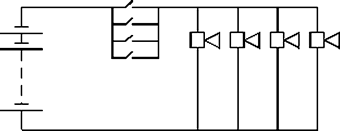
Abstract This paper examines the performance requirements of cables used in critical data circuits in all likely situations in which their continued performance is required. It shows that the requirements differ greatly between addressable and conventional alarm systems and notes that there is presently no universally applicable test protocol against which the suitability of the cable can be judged. Some easily measurable parameters are identified and measurement results from the main classification of fire survival cables are presented. Test criteria are proposed which could form the basis of an assessment system to demonstrate the suitability of cables to be used in analogue addressable alarm systems where data transmission in extremis is required. Introduction Primitive fire alarm systems, which are still in use today, consist of a sounder that is struck by the person discovering the problem. They are inherently reliable and provided that the gong and something to strike it with is actually present, one can be confident that the system can operate when required. Such systems are limited to small areas with sufficient audibility throughout from each manual alarm site. To allow larger buildings to be protected, simple manually activated electric alarms were developed where the single gong is replaced by many electric bells or klaxons distributed throughout the building to increase audibility and the striker is replaced by manual call buttons as shown in Figure 3. However these elements are neither sufficient nor inherently dependable in themselves and require both a power supply and electrical connections. All elements must operate reliably between the inception of a fire and the time when all occupants have heard the alarm. Whilst it is reasonable to assume that the call points, sounders and power supply are in a benign environment during operation, the cables could be passing through areas of fire and so need to perform under fire conditions. Fire alarm systems have continued to develop to incorporate automatic detection devices and multi-zoned alarms to enable phased evacuations to proceed. To simplify the installation of these systems, automatic sensors, manual call points and sounders incorporate electronic intelligence to allow connection by either a single daisy chain or bus connection as shown in Figure 4. In such configurations, each peripheral (sounder, manual call point, automatic detector) receives its power and participates in bi-directional signalling along one pair of conductors. The performance requirements of the interconnection cable must now include both a compatibility to pass DC current together with an ability to pass, without degradation or attenuation, the high frequency component that constitutes the signalling of information. This system is often referred to as an analogue addressable system as each of the peripherals on the loop must have a unique address to identify it to the panel and digitally returns an analogue measured value. Clearly the precise specifications of the cabling system are highly dependent upon the type of application used. Fire survival cable constructions There are three basic designs of fire survival cables that differ in the type of insulation that is used: Mineral insulation (MI), Mica-Taped insulation and inorganic (usually silicone based) polymeric insulation. Although some designs exist which offer a combination of these operating principles, each alone provides some degree of fire survival capability to enable compliance to some current test requirements. Fire survival cable constructions There are three basic designs of fire survival cables that differ in the type of insulation that is used: Mineral insulation (MI), Mica-Taped insulation and inorganic (usually silicone based) polymeric insulation. Although some designs exist which offer a combination of these operating principles, each alone provides some degree of fire survival capability to enable compliance to some current test requirements. Mineral Insulated Cables The basic construction of this cable is shown in Figure 1 where the copper cores are surrounded by compacted magnesium oxide encased in a copper sheath. This sheath is sufficiently large that it could be used as an earth based conductor.
Compacted magnesium oxide will not burn, does not emit fumes and remains stable up to 2,800°C. Since it is largely inert and mechanically stable, there is almost no change in either its dielectric or mechanical properties making MIC unaffected by fire, water and even direct impact on the cable. Such cables can be produced with either single or up to seven inner cores and in sizes ranging from 1.0mm2 to beyond 240mm2.Magnesium oxide can be made moisture resistant to significantly simplify installation, termination and jointing. Mica taped cables Such cables, produced to meet BS 7629 (or BS 7846 for the armoured range), can include from one up to and beyond 19 cores and in sizes from 1mm2 to beyond 400mm2. Armouring, if present, is not intended to improve the fire survival characteristics of the complete cable but is present to improve its mechanical resilience in normal operation.
Silicone based cables Summary Fire survival cable standards There are several European and country specific standards relating to these cables that differ materially only in the specification of the temperature of the fire, the severity and point of mechanical impact and the application of water to simulate a reasonably representative fire situation. MIC cable in Europe is tested to EN60702 that only calls for a 3-hour fire test at 950°C whereas the North American Standard, UL2196, calls for installation in a furnace at 1,000°C immediately followed by dousing the wall and cable to which it is clipped, with a fireman’s hose. In the UK, soft skinned cables to BS7629 are tested to BS6387 where individual samples can be subjected to; fire at 950°C for 3 hours (Class C), fire at 650°C and water spray from a sprinkler (Class W) or fire at 950°C on a bent sample with indirect impact (Class Z). The European test specification standard, EN50200, presently does not include a water test. With the exception of some customer specific tests which impose bending after exposure to fire, no assessment of the mechanical robustness of the cable is made after exposure to a fire situation. Considerable time and effort has, and no doubt will continue to be expended upon an appropriate definition of a fire situation, and in particular: the flame temperature, quantity and force of applied water together with the length of time that the cable should be expected to survive. These issues appear largely moot. The reality for small cables is that any polymeric insulation will be changed within the first few minutes of the test at any temperature above 250°C and remain in this new state indefinitely unless mechanical distortion is applied. If the (resultant) insulation is hygroscopic then, irrespective of either quantity or time during which a water spray is applied, the insulation will not fail until the waterproof barrier is breached. The specific details of the water test are therefore an assessment of the need for and mechanical robustness (if needed) of the waterproofing barrier. The occasional tapping of the board to which the cable is mounted, prescribed by some test protocols, cannot reasonably be relied upon to rigorously assess the mechanical robustness of the insulation after exposure to fire. Loop resistance in fire conditions Withstand voltage in fire conditions Summary Cable requirements from conventional alarm systems The system shown in Figure 3 represents a simplified conventional electric alarm where the power supply is from a battery to ensure that the system can operate in the absence of mains power. Whilst modern commercially available conventional alarm systems are more complex than that shown Figure 3 and include a panel, charging systems, annunciators and latches etc, it is adequate to demonstrate the principles and requirements of the cabling system. The cable, usually two cores, can be modelled as a simple ohmic resistor network where the cores are insulated to guarantee isolation. The design and operating criteria are that there is a sufficiently low resistance to ensure that the furthest sounder will receive sufficient voltage to operate and the insulation must be adequate to prevent significant conduction between the cores. The first requirement, loop resistance, defines the conductor cross-sectional area and the second, withstand voltage, defining the insulation property and thickness.
For cable that is required to operate during a fire both the continuity and withstand voltage, need to be maintained and these parameters are assessed by the current standards for fire survival cables. Cable requirements from analogue addressable alarm systems Figure 4 shows a system where each peripheral (sounder, manual call point or automatic detector) receives its power and participates in bi-directional signalling along one pair of conductors. The performance requirements of the interconnection cable must now include a capability to pass both low frequency current, as with conventional alarm systems - but here to power and charge the peripherals, together with a capability to carry without significant degradation or attenuation the high frequency components that constitute the bi-directional transferring of information.
This system is often referred to as an analogue addressable system as each of the peripherals on the loop must have a unique address to identify it to the panel and a measured value is returned. The schematic shows a daisy-chain loop, similar in hardware terms to either IBM’s® token ring topology or the Ethernet® bus topology. Each peripheral receives and transmits information directly to the next peripheral or bus rather than to a hub. Closing the loop provides a system that, if there is either a cable failure or peripheral failure, it is possible to instruct peripherals containing ring interrupters to break the ring around the failure therefore isolating it. The network then consists of two disconnected arms with the rogue elements removed. Whilst this ring topology with interrupters risks losing more peripherals from a single failure than would occur in a star topology, it uses significantly less cable that the star where each peripheral is routed back to the panel (hub) permitting single peripheral disconnections. Signalling protocols
The pale red sections represent times where full voltage is provided from the panel to enable the sensors to re-charge their internal power supplies and the pale yellow sections, where data is transferred and the sensors rely upon their internal power supply. The precise protocol varies between manufacturers but the example shown in Figure 6 is representative of those used practically. Such a system would allow for up to 256 peripherals on one ring with 16 commands being available with the scope to reply with a value accurate to 0.5% of the measured parameter. 15 bits are transmitted from the panel followed by a gap to allow the drivers to swap between transmit and receive, followed by a reply of 10 bits. This gives a total packet width as shown in Figure 6 of around 30 bits, including the switching gap.
The transmission is asynchronous, in that the receive and transmit clocks, whilst nominally at the same frequency (±10%) are not linked. They are synchronized at the beginning of each packet by start pulse, and as packet length is known, checked at the end with a stop bit. Peripherals, in addition to requiring digital circuitry to decode and check address information, need an analogue to digital converter to enable them to send their information in a binary form. To lower the cost of the sensors, an alternative system can be used where the returned information becomes a single pulse with its width representing the analogue value. Whilst this renders systems and sensors incompatible and slightly lowers the total packet width, the effect upon the following discussion is largely irrelevant as the requirement for addressing and digital information remains identical. There is a requirement for each sensor to be interrogated frequently, say every 20 seconds, and so assuming that the data transmission time must not exceed 50% of the total time to allow adequate power supply charging, then data rates will be around 2 kbaud. Should additional complexity be required (which increases the packet length) and increased scanning rates be required, baud rate of around 30 kbaud could be anticipated in the near future. Frequency components of data pulses
Only the odd harmonics are present and the Fourier coefficients decrease slowly to 0.5% for the 201st harmonic that is 6MHz if the baud rate is 30kbaud. Figure 7 shows the first 200 harmonic components together with the resultant square wave. An expanded section around the crossing area together with a bright yellow reference square wave is shown in Figure 8.
For data communication, the ability of the cable to pass higher frequencies becomes clear and should differential attenuation with frequency exist then the shape of the transmitted square wave will be significantly altered. Figure 9 shows the effect of attenuating the higher frequency components more than the lower ones with the most significant effects are close on the leading and trailing edges of the pulse. With sufficient frequency dependent attenuation, significant changes can occur which will render the detection of the received signal as ambiguous. At this point, data communication has become unreliable and the cable is not suitable for the intended application. Should there be a differential phase shift in cable then the received signal exhibits the degradation pattern shown in Figure 10. Here, there is some flattening of the falling edge and un-damped overshoot causing ringing and this too may also cause unreliable detection of the received signal.
In practice, a cable will have a combination of differential frequency attenuation and phase shift and it is these parameters that ultimately limit the bandwidth of the cable. The expected square edged data pulse at the receiver will be degraded to a point where recognition becomes unreliable and the system becomes increasingly sensitive to electromagnetic interference. These effects increase the error rate to a point where reliable data transmission ceases and communication can be said to have failed. Summary Mathematical cable models The simplistic model of the cables used for low frequencies ignore the effects of inductance and capacitance between conductors and a more accurate model shown in Figure 11 should be used. This consists of a semi-infinite series of sub-units that are expanded in Figure 12.
R (Ohm/m), is the resistance per unit length (loop resistivity), C (F/m), the capacitance per unit length, G (S/m), the reciprocal of inter-core resistance in Siemens per meter and L (H/m) the inductance per metre. The properties of the semi-infinite network can be calculated and are shown in Table I where w is the angular frequency, 2Pif.
The characteristic impedance is independent of length and, for an ideal cable where R = G = 0, it is both real and independent of frequency. For a cable pair the inductance and capacitance are dependent upon the separation distance s, the cable diameter, d and dielectric constant as shown in Equation 2. The characteristic impedance, which can be measured relatively easily, includes the variables that determine all other parameters and so provides a dependable indicator of all cable performance characteristics.
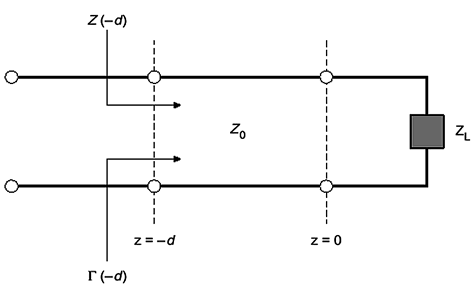
Connected transmission line
When Z0 = ZL the line is said to be matched and there is no reflection at the interface however, in an un-matched configuration the signal into the load, if it is a cable, will be attenuated as some power is reflected.
Reflections can cause standing waves within the cables which, in addition to causing attenuation, can cause problems for the transmitter and generate false data pulses further degrading the integrity of the network. Imbalance at transmitter and receiver are less important than un-matching throughout the cable network as it is possible to compensate electronically for the effects that are generated there. The absolute value of characteristic impedance is therefore less important than the need to ensure that uniformity exists throughout the entire cable system. To control the characteristic impedance of a cable, the manufacturer must maintain control over the core diameter, the thickness of the insulation, the dielectric constant of that insulation and the separation distance between the cores. However consistency of impedance at manufacture is insufficient since this must also be maintained throughout the anticipated performance envelope under which the cable is expected to operate, which for fire performance cables must include fire. Characteristic impedance of fire performance cables As shown to maintain characteristic impedance it is necessary that both the dielectric constant of the insulation and inter-core separation distance shall be unchanged during exposure to fire. This requirement is particularly challenging in cable systems where the insulation is polymer based as these both react to and are changed by high temperatures. Most solid polymers have a relative dielectric constant between 2 and 3 but the resultant char has a much lower value, significantly changing the cables’ characteristic impedance during a fire. The dielectric constant of magnesium oxide is around 10 and is unchanged by exposure to fire. The following measurements of cable impedance were carried out by exposing various fire survival cables to the test protocols of EN50200 together with water spray as defined in prA1. The flame temperature was set at 830°C and applied for 30 minutes although as anticipated, after the initial reaction when the silicone was oxidised, there were no further changes. Similarly the duration of the application of water had little effect with any changes happening almost immediately. Furthermore, it was noted that impacting the mounting plate had little effect. All of the cables tested met the simple continuity and voltage withstand tests. It has been shown that present, and likely future, analogue addressable fire alarm systems may use data rates up to 30kbaud which has frequency components between 10kHz and 6MHz. Performance above 10MHz can presently be ignored although it was recorded up to 100MHz. If attenuation at an interface of less than 10% in signal power is required then the transmission coefficient must be greater than 95% implying that the difference in characteristic impedance in different cables must be less than 10% as shown in Figure 14.
Silicone insulated fire performance cable
Figure 16 shows the cable performance after exposed to fire at 830°C where the changes were probably caused by alteration in the dielectric constant from solid silicone to silicone oxide char. Whilst the basic shape of the curve remains similar, the impedance differs from the standard cable to which it is connected by more than 10% at 90kHz and above 600kHz. These interfaces will cause signal attenuation and therefore data communication may be unreliable at data rates exceeding 6kbaud.
Figure 17 shows the performance after exposure to water. Here there are two effects: a change in the shape of the curve and also an alteration to some values. It is assumed that some water has permeated the waterproof barrier that, although insufficient to rupture the 2Amp fuse that is the determining issue within EN 50200, is sufficient to cause identifiable changes in impedance. The water has probably further changed the dielectric constant of the silicone oxide char and also decreased the insulation resistance. The former will simply move the absolute value of the impedance whereas the latter will cause a shape change as the frequency dependence of the impedance increases as shown in Table I. After exposure to water the impedance differs by more than 10% at almost all frequencies. The differences in impedance between the unaffected cable and this portion of it are sufficiently large to suggest that data communication at any useful rate may be unreliable, rendering an addressable alarm system unable to function in a dependable fashion.
Mica-taped fire performance cable
Whilst this cable construction does not rely upon a moisture barrier to comply with the requirements of EN 50200, water still significantly affects the cables performance probably because the dielectric constant of the separator material is altered. Mineral insulated fire performance cable
As anticipated, there is no significant change in the characteristic impedance from any of the test protocols. The insulation, magnesium oxide, is inert and its electrical properties are unchanged at temperatures less than its melting point of 2,800°C. The waterproofing member is a thick copper outer which again remains unchanged up to its melting point of 1,083°C. This cable is therefore capable of transmitting data under fire situations at rates beyond 100kbaud making it the cable of choice for addressable alarm systems. Conclusion The commentary of the new re-draft of BS 5839-1 (2002); Code of Practice for Fire detection and alarm systems for buildings, advises that if a cable is to be used in an addressable alarm system then it must be compatible with the characteristics of the data transmission e.g. speed and waveform, and remain so for an adequate length of time during the relevant exposure to fire for the category of cable. The standard however fails to propose a test criterion to demonstrate a cable's suitability. The standard also specifically requires that steps be taken to minimise false alarms, many of which arise may because of communication issues caused by unmatched cables and terminations being used. Data cables that are to be used for LANs have their characteristic impedance specified and must remain within 10% of the nominal value (100??) over the frequency range (data speed) that is to be used. For cables that are required to carry data under fire conditions it would seem logical to use this concept but also measure this critical parameter under the conditions that are deemed to represent a fire. The author proposes that the test of suitability of a fire performance cable intended for use in fire alarm systems should prescribe that: 1. The nominal characteristic impedance of the cable must lie within the range recommended by the manufacturer of the communication equipment to which it is to be connected.
|
||||||||||||
|
||||||||||||